Sorry.
---ETA: Apparently, while I was writing this, the Senate moved to kill not one, but TWO infrastructure jobs bills. S.1769 basically failed to move on to the next step, due to a whole lot of apathy when the Senate voted. Info here. I haven't been able to find a break down on exactly who voted in what direction. Fuck it. Never mind. Skip the whole damn post. I'm going to write hate letters to my reps.---
Actually, I've always BEEN political, but I kept it off the internet while the hub was active duty because when your husband's in the Navy, calling the Commander in Chief of the Armed Forces a flapping twat over the internet is unwise. (But, hey. Bush Jr? Flapping twat is the nicest thing I called him.)
I shall try to remain moderate for all of you, because nothing's more tedious than listening to some extremist rant, and we're all entitled to our own opinions, anyway. But I'm pissed. Have I mentioned I'm pissed?
A short bit of lead-in, for perspective, and because I'm a history geek and today's current events are tomorrow's history, so for crying out loud, get the details right. And because not all of you are from the US (if you're not, and you're still reading, thank you) and don't know this stuff. And because not all of you had the great government teacher I did.
When the president introduces a bill (potential law or appropriation of funds to start a project, declare war*, like that) the Senate (two per state) and the Representatives (determined by population, one per smaller region) vote on what they call a "Cloture Motion" or just Cloture. Think of it like closure. Do they vote yes, and axe the thing dead on the spot, or do they vote no, and discuss it further?
Our economy, like everyone else's, is in the toilet right now. Our president (who I'm rather indifferent about) has been trying to pass bills that would create new jobs. HIS JOB, wouldn't you say? Looking after the citizenry? We're at a stage where unemployment has only been worse, once. Chart here. The country needs jobs.
The president, being a smart guy, figured out one thing that would work would be to put people to work fixing infrastructure (roads, bridges, like that), which is in a pretty sorry state because we spend significantly less than the rest of the world on keeping our country paved and safe. Chart here. (Interesting editorial drawing on that chart, by the way.) This is a tried-and-true plan. It's one of the major ways FDR put people to work during the Great Depression (and where a lot of our really awesome stone bridges come from); top economists NOW are suggesting it. The president put it together with a lot of other, similar ideas for job creation, and introduced the bill.
So what did the Senate do?
Yup. Killed it. It's dead in the water. You can see how your senators voted here.
It was trimmed down and broken into pieces, and the infrastructure portion was re-introduced and is currently under consideration for a motion to proceed. It is bill number S.1769, if you wanna do your own searches on it. (Here's a good summary.) Basically, they're deciding whether to kill it. Since they're proposing to pay for this project by a .7% tax on people whose income is over a million dollars, I bet it get shot down, just like the last time. It's looking REALLY close. Got an opinion on this? I hope you do. Track down your senators and tell them how you feel about it.
You guys who aren't stuck here? Technically it's not your problem, and you're not their jurisdiction, so to speak, but I bet they'd take notice if enough outraged e-mails from outside the country showed up in their in box. If you want, you can e-mail my senator who voted against the last version of the bill, Pat Toomey. I intend to; as always, you're welcome to join in the fun.
There you have it. My radical agenda. Jobs for people and maybe a few fixed bridges. ('Cause the husbeast? The industrial inspector? He'll tell you, the bridges in this country are FRIGHTENING.) I hope you won't all hate me for wanting some millionaires to pony up a few bucks to make it happen.
And just to warn you... I consider myself a conservative because I think the Constitution should be followed strictly (including using the provisions for amending it). But the GOP wouldn't have me as a gift. I think "government by the people, for the people" is a mandate for public health care, among other things.
Yesterday's general strike in Oakland? Except for the vandalism? Awesome.
I am not a pinko commie. I'm a democratic socialist. Also, my dad was in the UAW. I've been blue collar all my life. So. Y'know. Oh, hell, just call me Pinko.
---
*Included for the folks who wouldn't know how the system works here: Yes, Congress has to vote (in favor, obviously) in order to declare war. That's why Iraq is a war and Afghanistan isn't. Afghanistan is a "police action". Total bullshit? You betcha.
Thursday, November 03, 2011

Wednesday, November 02, 2011
Vikings, and navigation. And rocks.
This was supposed to be a post about the culture shock of living in the boonies of Pennsylvania. But then this showed up in my RSS feeds this morning, and, hell, there's always time later to discuss how weirded out I am to be living in an area where people steal bridges.
Right. So, the vikings. Great seafarers, discovered and settled Iceland and Greenland, poked around in N America before most of Europe knew it existed. All very cool. But there's one thing that most people don't think about. Okay, there's more than one, but there's one that's the real biggie. How did they figure out where they were going?
Being vikings and all, a great deal of their sailing activity was done in or near the Arctic Circle. Which means they did most of their traveling (all they could, I'm sure) in summer. Summer, when, in the Arctic, the sun never goes down. How are you supposed to navigate by the stars, in the Land of the Midnight Sun?
I first encountered this question when I had a job selling crystals and jewelry at a job in Waikiki, years ago. Being me, I was geeking out, researching the history of crystals, and ran into the problem, which historians and tech people have been puzzling over for centuries.
There are references in the Sagas about "A stone with which one could see where the sun was in Heaven." There are mentions of "sun stones" in church inventories, descriptions of gifts (a horse and a sun stone), and other discussions. They were definitely a well-known and valuable (obviously) thing.
But WHAT?
Everyone who knew anything about the situation (rocks, navigation, and history) figured it was probably some kind of feldspar - crystals which, due to their crystalline structure, would polarize light. Moonstone, rainbow moonstone, spectralite, and Labradorite are some of the names used for semi-precious stones used in jewelery that have the effect to some degree or other, hence the pretty reflective qualities of them. (Rainbow moonstones are my personal favorite, for jewelry purposes.) Still, there's a shitload of feldspars out there, and no one was quite sure what in hell the vikings were using.
My choice was always iolite, which I'm not sure is technically a feldspar, now that I think of it, though it has similar diffraction behavior. (I use gem terms for rocks, because I learned about them at a jewelry store rather than in a geology class.) There are clear forms of iolite in a gray-blue that, cut properly, would work exactly like a polarized eyeglass. Check it:
 See how it refracts light, and makes the stone look like it's different colors, from different angles? Using one of these would be like finding the sun in the clouds, wearing polarized sunglasses. Which I've done. It would work. The nearest source of iolite for the vikings would have been Cornwall, in the UK. Or Connecticut in N America - but how would they have made it to N America to find the stones, if they hadn't had them first? This is a logistical problem, obviously.
But it appears I was wrong. (SHOCK!)
They discovered an "Icelandic Spar" on a shipwreck that went down in 1592. It so happens that, because they're so freaking common, they're really easy to get hold of, and I actually own one. (What? I'm a geek!) Here it is.
 You can see, by the way the light's reflecting off it, that it's got some odd refractive index, and I wasn't even trying. You can also see that it breaks along planes in the crystal structure, which would make shaping it for sunglasses purpose really easy. Probably the deciding feature is, it's so common in Iceland that I've heard people could simply pick them up off the ground at one point. It's been confirmed by scientists who know this stuff that yes, it would work to find the sun on cloudy or bright days.
Solar navigation. With rocks. I love history.
PS: I sold a metric assload of iolite and calcite jewelry to sailors, with this information. Geeks, unite!
ETA: An article from Discover News, with a great photo. Thanks to @sharkgrl for the info!
Right. So, the vikings. Great seafarers, discovered and settled Iceland and Greenland, poked around in N America before most of Europe knew it existed. All very cool. But there's one thing that most people don't think about. Okay, there's more than one, but there's one that's the real biggie. How did they figure out where they were going?
Being vikings and all, a great deal of their sailing activity was done in or near the Arctic Circle. Which means they did most of their traveling (all they could, I'm sure) in summer. Summer, when, in the Arctic, the sun never goes down. How are you supposed to navigate by the stars, in the Land of the Midnight Sun?
I first encountered this question when I had a job selling crystals and jewelry at a job in Waikiki, years ago. Being me, I was geeking out, researching the history of crystals, and ran into the problem, which historians and tech people have been puzzling over for centuries.
There are references in the Sagas about "A stone with which one could see where the sun was in Heaven." There are mentions of "sun stones" in church inventories, descriptions of gifts (a horse and a sun stone), and other discussions. They were definitely a well-known and valuable (obviously) thing.
But WHAT?
Everyone who knew anything about the situation (rocks, navigation, and history) figured it was probably some kind of feldspar - crystals which, due to their crystalline structure, would polarize light. Moonstone, rainbow moonstone, spectralite, and Labradorite are some of the names used for semi-precious stones used in jewelery that have the effect to some degree or other, hence the pretty reflective qualities of them. (Rainbow moonstones are my personal favorite, for jewelry purposes.) Still, there's a shitload of feldspars out there, and no one was quite sure what in hell the vikings were using.
My choice was always iolite, which I'm not sure is technically a feldspar, now that I think of it, though it has similar diffraction behavior. (I use gem terms for rocks, because I learned about them at a jewelry store rather than in a geology class.) There are clear forms of iolite in a gray-blue that, cut properly, would work exactly like a polarized eyeglass. Check it:

But it appears I was wrong. (SHOCK!)
They discovered an "Icelandic Spar" on a shipwreck that went down in 1592. It so happens that, because they're so freaking common, they're really easy to get hold of, and I actually own one. (What? I'm a geek!) Here it is.

Solar navigation. With rocks. I love history.
PS: I sold a metric assload of iolite and calcite jewelry to sailors, with this information. Geeks, unite!
ETA: An article from Discover News, with a great photo. Thanks to @sharkgrl for the info!
Tuesday, November 01, 2011
NaNoWriMo. Sorta.
It's November, the month that crazy people try to write a novel in thirty-one days. That's way too extreme for me (good luck to you folks trying it), but I thought I'd use the buzz around the internet to get me back to blogging.
I want to write a blog post every day this month.
Now that (I think) all of the zombie-making drug is finally out of my system, I'm having to get things going again; exercise, knitting, spinning, WRITING. So I'm Just Gonna Do It.
Here we go.
---
I've been pondering WHAT to blog for quite a while. I think really I need to quit thinking and start writing. But, topic ideas include more history, some entries on world religions (history and description, not editorializing), and like that. Plus there's that series I did years ago on color; I could do white, or black, or specific dyes. The discussions of fashion designers remain popular. And I've got decades of fashion left to do.
Plus there's always plants. And with Thanksgiving coming up I'll probably start babbling about food soon.
Right. I shall kick myself in the ass as needed.
I want to write a blog post every day this month.
Now that (I think) all of the zombie-making drug is finally out of my system, I'm having to get things going again; exercise, knitting, spinning, WRITING. So I'm Just Gonna Do It.
Here we go.
---
I've been pondering WHAT to blog for quite a while. I think really I need to quit thinking and start writing. But, topic ideas include more history, some entries on world religions (history and description, not editorializing), and like that. Plus there's that series I did years ago on color; I could do white, or black, or specific dyes. The discussions of fashion designers remain popular. And I've got decades of fashion left to do.
Plus there's always plants. And with Thanksgiving coming up I'll probably start babbling about food soon.
Right. I shall kick myself in the ass as needed.
Monday, October 31, 2011
Happy Halloween!

She wanted to go as Olivia, but we got to the costume store and she spotted the wall o' wings, and she just had to have the blue and purple ones with GLITTER. So, fairy princess again. For the third or fourth year in a row. I've lost track. But, hey, you're a girl, you're six, you gotta be a fairy goddamn princess, right?

Oh, and she also demonstrated her geek heritage.

While everyone was running around trick-or-treating, I ducked over to visit with the neighbors for a bit. One of the first things she asked was, "Hey, that wheel thing you use on the back porch. I keep forgetting to ask. What the hell is that?" It's my spinning wheel. Heeheehee. She wanted to know what I DID with it. I explained how I like to spin and knit socks, then wear them and feel clever. Her husband, an engineer, thought that WAS pretty clever.
Friday, October 28, 2011
KAL 07.1: Where we're at.
And where we're going.
There was some concern about the last round of directions. So to answer them, first, a photo of a finished EPS sweater:
 The shaky orange line is where your needles are, right now.
Yes, there is more than 100% of stitches on the needle. You'll need that extra fabric to put your boobs and shoulders into. It is supposed to be there. (As I recall, you should be in the neighborhood of 138% right now, but don't fret if you're of by an inches' worth of stitches.)
Yes, at the moment, the arm pits are giant gaping holes. That's okay. We'll be grafting the arm pits shut as part of the finishing. Think of them kind of like inside-out sock toes, if that helps. (If it confuses you, forget I ever typed it.)
We will begin decreasing all those extra stitches again quite soon, and quickly; eight stitches every other round. It creates the perfect shoulder for a casual sweater.
All is well. You're doing fine.
There was some concern about the last round of directions. So to answer them, first, a photo of a finished EPS sweater:

Yes, there is more than 100% of stitches on the needle. You'll need that extra fabric to put your boobs and shoulders into. It is supposed to be there. (As I recall, you should be in the neighborhood of 138% right now, but don't fret if you're of by an inches' worth of stitches.)
Yes, at the moment, the arm pits are giant gaping holes. That's okay. We'll be grafting the arm pits shut as part of the finishing. Think of them kind of like inside-out sock toes, if that helps. (If it confuses you, forget I ever typed it.)
We will begin decreasing all those extra stitches again quite soon, and quickly; eight stitches every other round. It creates the perfect shoulder for a casual sweater.
All is well. You're doing fine.
Monday, October 24, 2011
The global village.
This is one that's been making my brain hurt for a while.
The husbeast, since he retired, has been working at a factory that builds turbines. He inspects them; makes sure they aren't cracked, that the welds are solid, that no one machined it too small by accident. That kind of thing*. The factory is owned by an international conglomerate that builds all sorts of things meant for power plants, refineries, and like that. Major, very large, heavy industry.
A few months ago, he mentioned to me that the factory was going to be doing a new trick; testing the turbines. Not just the bits they build here in SW Pennsylvania out in the boonies, but big, hunormous things shipped in from all over, the finished products built by his factory and others, in working order. It turns out, the conglomerate was running their main 'test floor', as they call it, in Japan. Since the tsunami knocked out the reactors there, they've been on power rationing and don't know when it'll end. Looking around, they decided the best facility to take over the job would be, yes. This place here in the boonies of Pennsylvania.
While all this made sense to me, I was thinking big picture: HOW much were they going to spend, shipping stuff halfway around the world for testing? I knew the turbines the husbeast built were big, but geez, how big could they be? So I asked how much power they were expecting to use, that it was worthwhile.
100 megawatts. They needed 100 megawatts of power.
I didn't run around doing the Doc Brown "ONE POINT TWENTY-ONE JIGAWATTS!?!" while tearing out my hair, but it was a near thing.
The output of an ENTIRE power plant, the WHOLE DAMN THING, is between 400 and 600 megawatts. (It varies a lot; fuel, conditions, design, etc. But that's the neighborhood. Nuclear submarine reactors produce about 20 megawatts, at least according to public info.) That joke we all make about how we turn on the air conditioning in our house, and they know it at the power plant? IT WILL BE TRUE for this test floor. They're having to put in a power grid substation for it. A hundred megawatts.
We are living in the future. A tsunami in Japan has created a shift in the power grid in rural Pennsylvania. Look out for butterflies.
-----
*The husbeast's job consists of all sorts of wild and crazy methods, from the very, exceedingly simple to the really Meet George Jetson futuristic stuff. The first thing he did when he went to work there was make them buy new measuring equipment like calipers. He's the one who calls regular rulers "a fucking wooden stick" with a lot of sneering. One night he was asked to check some parts for cracks, just a quick check. He was in a hurry, so he walked along them and hit them with his flashlight. Ding, ding, ding, thunk. He pointed out the thunk and said it was cracked. He was right. This is where the term 'dead ringer' comes from and goes back into prehistory in bell making. The guys he works with act like he's a combination of Gandalf and Mike Holmes.
The husbeast, since he retired, has been working at a factory that builds turbines. He inspects them; makes sure they aren't cracked, that the welds are solid, that no one machined it too small by accident. That kind of thing*. The factory is owned by an international conglomerate that builds all sorts of things meant for power plants, refineries, and like that. Major, very large, heavy industry.
A few months ago, he mentioned to me that the factory was going to be doing a new trick; testing the turbines. Not just the bits they build here in SW Pennsylvania out in the boonies, but big, hunormous things shipped in from all over, the finished products built by his factory and others, in working order. It turns out, the conglomerate was running their main 'test floor', as they call it, in Japan. Since the tsunami knocked out the reactors there, they've been on power rationing and don't know when it'll end. Looking around, they decided the best facility to take over the job would be, yes. This place here in the boonies of Pennsylvania.
While all this made sense to me, I was thinking big picture: HOW much were they going to spend, shipping stuff halfway around the world for testing? I knew the turbines the husbeast built were big, but geez, how big could they be? So I asked how much power they were expecting to use, that it was worthwhile.
100 megawatts. They needed 100 megawatts of power.
I didn't run around doing the Doc Brown "ONE POINT TWENTY-ONE JIGAWATTS!?!" while tearing out my hair, but it was a near thing.
The output of an ENTIRE power plant, the WHOLE DAMN THING, is between 400 and 600 megawatts. (It varies a lot; fuel, conditions, design, etc. But that's the neighborhood. Nuclear submarine reactors produce about 20 megawatts, at least according to public info.) That joke we all make about how we turn on the air conditioning in our house, and they know it at the power plant? IT WILL BE TRUE for this test floor. They're having to put in a power grid substation for it. A hundred megawatts.
We are living in the future. A tsunami in Japan has created a shift in the power grid in rural Pennsylvania. Look out for butterflies.
-----
*The husbeast's job consists of all sorts of wild and crazy methods, from the very, exceedingly simple to the really Meet George Jetson futuristic stuff. The first thing he did when he went to work there was make them buy new measuring equipment like calipers. He's the one who calls regular rulers "a fucking wooden stick" with a lot of sneering. One night he was asked to check some parts for cracks, just a quick check. He was in a hurry, so he walked along them and hit them with his flashlight. Ding, ding, ding, thunk. He pointed out the thunk and said it was cracked. He was right. This is where the term 'dead ringer' comes from and goes back into prehistory in bell making. The guys he works with act like he's a combination of Gandalf and Mike Holmes.
Saturday, October 22, 2011
KAL 07: Joining it all up.
Yes. FINALLY. Really sorry.
Having read my blathering post, I've come back to the top and am putting in a checklist of steps, so that -hopefully- between the short list and my blather, it will make sense. If it doesn't, you may pelt me with acrylic yarn. Or ask questions. Whichever seems most appropriate.
-Figure 8% of your 100% figure. For me, it is 18 stitches. (222 x 8% = 18) These are your armpit stitches.
-Knit across the body to where you're putting the first sleeve. Put armpit stitches on stitch holders, both on the body and the sleeve. (I suggest using an even number of stitches for the body, and one more for the sleeve, to make grafting easier later; mine was 18 stitches body, 19 stitches sleeve.)
-Put the two arm pits together so they meet, like they will when the sweater is finished.
-Put some kind of stitch marker on the body needle. Knit the sleeve stitches onto the body needle. Put another stitch marker. Knit across the back of sweater.
-Repeat for the other sleeve, when you knit across to it. Don't forget the stitch markers.
Confused? I hope to hell not. Details, blather, and photos of the process below.
So. The whole point of doing a sweater is, you know, having a sweater. It needs sleeves. The sleeves need to be opposite each other, on the body. Can't stress that enough. And if there's a cardigan opening, it needs to be equidistant, between the sleeves. Sure, you're laughing, going "no kidding", but there have been sweaters produced with arms in the wrong place. More than once. And I'm not the only one who has done it.
Now, if you'd marked the sides of your sweater as you knit the body, with stitch markers or loops of string, you know where the arm pits go. If not, you might wanna do that, now. Get your 100% figure, divide it in half. That gives you the number of stitches on front and back. (My 100% figure is 222, so that's 111 each, front and back.)
Remember, steek stitches (for cut cardigans) do not go in the 100% figure. And the steek? It goes in the middle of the front. Between the arms. Just sayin'.
You will put armpit stitches on holders (I suggest actual stitch holders, rather than putting them on a string, because the string allows too much stretch and distortion). Then you will put all the other stitches on a single circular needle: Front of sweater, outside of sleeve, back, outside of other sleeve, then the front again. (Giving a quick overview before digging into details.)
Why don't I shut up now and put up some pictures? There's an idea.
Sleeve with armpit stitches on stitch holders.
 Yeah, yeah, I know there's technical terms for this stuff, but y'all know what an armpit is, don't you? If you can't tell, there, the yarn end for the sleeve is right in the middle of the stitches on the holders. It will make grafting a little difficult later, but if you're going to have a bunch of darning and irregular rows meeting, you want it buried in your arm pit, not out on your shoulder for God and everyone to see.
Body, with stitches on stitch holders.
 I use the body yarn to knit the sleeve into the needle with; the end of the sleeve yarn is in the armpit.
Getting ready to knit the sleeve into the body needle.
 The sleeve is on the left, the body is on the right. Both sets of armpit stitches are together in the middle. The sleeve needle is silver, the body needle is blue. With this manouver, all the stitches will wind up on holders (armpit) or the body needle (body and sleeve).
With the sleeve and body on the body needle.
 Reading the stitches left to right, from where my hand is holding the tips of the needles, there are sleeve stitches, then after the stitch marker on the right side, center of the screen, are the front body stitches. (The last stitch marker, upper right corner marks the steek, central front, because I'm making a cardigan.)
From there, I knit across the back and repeated the entire process on the other sleeve.
The advantage of doing it this way, rather than simply shoving stitches on and off needles and shuffling them around that way (which you are welcome to do instead) is, it reduces the odds of dropped stitches. It also makes it possible to knit one of these sweaters with just two circular needles, one for sleeves and one for body. Knit on the first sleeve, knit to where the second sleeve belongs, use your newly empty sleeve needle to make the second sleeve, knit it on, and you're ready to go.
---
With the sleeves and body put together, you need to knit an inch or two plain. This dictates the depth of the arm holes in your finished product. That is largely a matter of personal taste. I would do at least one inch, possibly two or three, depending. Things to consider:
-Smaller people need less arm room than larger people. (Kid sweater? One inch is fine. Medium adult sweater? Probably two. Really large adult sweater? Consider three.)
-Jackets and cardigans and pullovers intended to be worn over other clothes are a great deal more comfortable with larger arm holes.
For reference, and if anyone's curious, I'm doing probably two and a half inches on mine. It's a cardigan and I like my clothes on the loose side, usually.
---
After this will be shoulder decreasing and possible neck decreasing. Now's the time to decide if you want a crew neck or a V-neck.
Having read my blathering post, I've come back to the top and am putting in a checklist of steps, so that -hopefully- between the short list and my blather, it will make sense. If it doesn't, you may pelt me with acrylic yarn. Or ask questions. Whichever seems most appropriate.
-Figure 8% of your 100% figure. For me, it is 18 stitches. (222 x 8% = 18) These are your armpit stitches.
-Knit across the body to where you're putting the first sleeve. Put armpit stitches on stitch holders, both on the body and the sleeve. (I suggest using an even number of stitches for the body, and one more for the sleeve, to make grafting easier later; mine was 18 stitches body, 19 stitches sleeve.)
-Put the two arm pits together so they meet, like they will when the sweater is finished.
-Put some kind of stitch marker on the body needle. Knit the sleeve stitches onto the body needle. Put another stitch marker. Knit across the back of sweater.
-Repeat for the other sleeve, when you knit across to it. Don't forget the stitch markers.
Confused? I hope to hell not. Details, blather, and photos of the process below.
So. The whole point of doing a sweater is, you know, having a sweater. It needs sleeves. The sleeves need to be opposite each other, on the body. Can't stress that enough. And if there's a cardigan opening, it needs to be equidistant, between the sleeves. Sure, you're laughing, going "no kidding", but there have been sweaters produced with arms in the wrong place. More than once. And I'm not the only one who has done it.
Now, if you'd marked the sides of your sweater as you knit the body, with stitch markers or loops of string, you know where the arm pits go. If not, you might wanna do that, now. Get your 100% figure, divide it in half. That gives you the number of stitches on front and back. (My 100% figure is 222, so that's 111 each, front and back.)
Remember, steek stitches (for cut cardigans) do not go in the 100% figure. And the steek? It goes in the middle of the front. Between the arms. Just sayin'.
You will put armpit stitches on holders (I suggest actual stitch holders, rather than putting them on a string, because the string allows too much stretch and distortion). Then you will put all the other stitches on a single circular needle: Front of sweater, outside of sleeve, back, outside of other sleeve, then the front again. (Giving a quick overview before digging into details.)
Why don't I shut up now and put up some pictures? There's an idea.
Sleeve with armpit stitches on stitch holders.

Body, with stitches on stitch holders.

Getting ready to knit the sleeve into the body needle.

With the sleeve and body on the body needle.

From there, I knit across the back and repeated the entire process on the other sleeve.
The advantage of doing it this way, rather than simply shoving stitches on and off needles and shuffling them around that way (which you are welcome to do instead) is, it reduces the odds of dropped stitches. It also makes it possible to knit one of these sweaters with just two circular needles, one for sleeves and one for body. Knit on the first sleeve, knit to where the second sleeve belongs, use your newly empty sleeve needle to make the second sleeve, knit it on, and you're ready to go.
---
With the sleeves and body put together, you need to knit an inch or two plain. This dictates the depth of the arm holes in your finished product. That is largely a matter of personal taste. I would do at least one inch, possibly two or three, depending. Things to consider:
-Smaller people need less arm room than larger people. (Kid sweater? One inch is fine. Medium adult sweater? Probably two. Really large adult sweater? Consider three.)
-Jackets and cardigans and pullovers intended to be worn over other clothes are a great deal more comfortable with larger arm holes.
For reference, and if anyone's curious, I'm doing probably two and a half inches on mine. It's a cardigan and I like my clothes on the loose side, usually.
---
After this will be shoulder decreasing and possible neck decreasing. Now's the time to decide if you want a crew neck or a V-neck.
Catch up.
You know, I am continually amazed at the drugs that are legal, and the drugs that aren't. I've spent a month going through withdrawal from a prescription drug, AFTER weaning off it for two months before that. And it's been worse than the time I took Percocet several times daily for a year, then quit cold turkey. But marijuana is illegal. This makes no fucking sense to me. (For those just checking in, I've got a chronic pain thing going on, and all this is under doctor's supervision, legal, and blah blah. Just annoying as fuck.)
I don't think I've gone two weeks without blogging since I started this thing in 2006. This whole mess royally pisses me off. Royally.
Anyway. I will comment on comments, because I got nothin', but I wanted to let youse guys know I'm still alive.
---
Vogue Knitting. A designer checked in and left a comment on the last review (it's over there). She asked me to correct the spelling of her name. Oops. Sorry about that. Sincerely. I did fix it, and cut and pasted it straight from your e-mail, so I hope it's correct now.
The designer also clarified the sizing issue with VK, and confirmed what we already know - that they dictate the sizes, not the designer. I guess she didn't read back further to realize we know that too. But at this point, I'm over blaming designers for the shitty sizes in VK, and I'm sorry if that last review read differently. Don't get me wrong; I still think it's complete horse shit. I just realize the designers aren't the ones producing stuff in two ridiculous sizes.
---
Stink bugs. Someone asked if they really stink. Not exactly. The name, as far as I understand it, is in reference to how they work: When you squish a stink bug, they send off a pheromone or stink or something, and every other damned stink bug in the tri-state area homes in on it, and goes straight for your head. That's why people go to such extreme lengths to avoid smashing them; not the stink, specifically, but the result. I've also been told that inducing death by other means (pesticides and/or soap), they still stink and still bring in all their relatives.
Over the summer, I got mad and smacked one, didn't kill it, just swatted at it as it flew past, and it STILL called in all its icky little friends. They're evil. And disgusting. And pretty damn ugly, too.
---
The glasses. I'm calling the Progressives my vertigo goggles. Thanks to the drug fun I'm having, I can't be sure it's the glasses, though, so I'm still wearing them off and on to try getting used to them.
My optician's nurse had shared the "point your nose at what you want to see" tip, thanks to all of you who shared it. It does help some, but now I'm wondering if all the bobbing and weaving I'm doing has something to do with it. Oy. Well, I'll keep experimenting.
---
Last week was my birthday. The husbeast got me another folio of Niebling patterns. If I ever get through my current knitting list, there will be lace craziness going on around here. It's a great motivator; I desperately want to cast on the most insane doily I can find, but I can't 'til I get the KAL done, and some Yule gifts.
And speaking of, now that I've done some writing calisthenics (hey! I remember what a sentence is!) I am now off to write the LONG overdue KAL post.
I don't think I've gone two weeks without blogging since I started this thing in 2006. This whole mess royally pisses me off. Royally.
Anyway. I will comment on comments, because I got nothin', but I wanted to let youse guys know I'm still alive.
---
Vogue Knitting. A designer checked in and left a comment on the last review (it's over there). She asked me to correct the spelling of her name. Oops. Sorry about that. Sincerely. I did fix it, and cut and pasted it straight from your e-mail, so I hope it's correct now.
The designer also clarified the sizing issue with VK, and confirmed what we already know - that they dictate the sizes, not the designer. I guess she didn't read back further to realize we know that too. But at this point, I'm over blaming designers for the shitty sizes in VK, and I'm sorry if that last review read differently. Don't get me wrong; I still think it's complete horse shit. I just realize the designers aren't the ones producing stuff in two ridiculous sizes.
---
Stink bugs. Someone asked if they really stink. Not exactly. The name, as far as I understand it, is in reference to how they work: When you squish a stink bug, they send off a pheromone or stink or something, and every other damned stink bug in the tri-state area homes in on it, and goes straight for your head. That's why people go to such extreme lengths to avoid smashing them; not the stink, specifically, but the result. I've also been told that inducing death by other means (pesticides and/or soap), they still stink and still bring in all their relatives.
Over the summer, I got mad and smacked one, didn't kill it, just swatted at it as it flew past, and it STILL called in all its icky little friends. They're evil. And disgusting. And pretty damn ugly, too.
---
The glasses. I'm calling the Progressives my vertigo goggles. Thanks to the drug fun I'm having, I can't be sure it's the glasses, though, so I'm still wearing them off and on to try getting used to them.
My optician's nurse had shared the "point your nose at what you want to see" tip, thanks to all of you who shared it. It does help some, but now I'm wondering if all the bobbing and weaving I'm doing has something to do with it. Oy. Well, I'll keep experimenting.
---
Last week was my birthday. The husbeast got me another folio of Niebling patterns. If I ever get through my current knitting list, there will be lace craziness going on around here. It's a great motivator; I desperately want to cast on the most insane doily I can find, but I can't 'til I get the KAL done, and some Yule gifts.
And speaking of, now that I've done some writing calisthenics (hey! I remember what a sentence is!) I am now off to write the LONG overdue KAL post.
Thursday, October 06, 2011
Mud and weeds and stink bugs.
Oh my.
At this point, I don't know if I'm so fucked up because I'm messing with my main pain medication, or because I'm sick. Most likely a combination of the two, 'cause I've definitely got a sinus infection. So, you know, FUCK.
Anyway. Other stuff I've found interesting lately. Let's talk about that. More interesting than green snot.
---
The big archeology news of the past week-ish, is this:
 See the little lines, there? They're called flutings, and what they are is simply a spot where someone's run their fingers over some damp mud in a cave. Apparently they are found world wide, but the study that's been getting news is about a cave in France. (I don't know if France is REALLY the center of the world for cave art, or whether it just seems like that because they have been settled a looooong time and their countryside has been explored extensively.) The flutings in that picture there are possibly as old as 13,000 years.
See how they look like a kid did them? Ran their fingers through, did some doodling? That's because a kid REALLY DID DO IT. Scientists have done studies that make it possible for them to estimate the ages and genders of the people doing the flutings, and they've found that many of them were made by children! Also, the children have drawn not only on low walls, but up across high ceilings and very deep underground, so adults almost had to be helping them.
No one knows what exactly it means. And it's kind of nice that for once, the archeologists are actually admitting it. Some have admitted it COULD have a ritual purpose, but most of the spin on it seems to be saying it was little kids doodling, JUST LIKE THEY DO NOW.
Taking precise measurements, they can sometimes track on individual's work. They think the most prolific of the doodlers was a little girl, somewhere around age five. What this means is, 13,000 years ago, there was a little girl doing the exact same thing that MY little girl would do in a cave with muddy walls.
The mental image of a group of muddied-up children tumbling out of the cave after a day spent fooling around makes me smile. It's all so, well, NORMAL. Some things don't change.
I love history.
More detail and less editorializing (and also video) available at the NPR web site.
---
Also, I've been reading this:
 "Weeds", by Richard Mabey. Basically, a history of weeds. Both culturally (what do we consider a weed, and why?) and botanically (how they grow and what they're good for). He's a plant freak, and reading the book kind of reminds me of reading my own blog posts about plants. So if you like the stuff you've read here on leBlog, you'd enjoy this book. It's fairly new, so your library should have it, if you're unwilling to spend money for weeds. Gardeners, it will help you. Plus, hey, plants. Plants are cool.
---
All else is much the same. I finished the one sleeve and started the next; this would be the next KAL post, but I don't want to try to explain something clearly while I'm tired and full of snot. So that's coming tomorrow.
There is a stink bug in my living room. This displeases me greatly. But if Sekhmet eats it, I'll try to get photos. CHINA. COME AND GET YOUR BUGS AND TAKE THEM HOME.
At this point, I don't know if I'm so fucked up because I'm messing with my main pain medication, or because I'm sick. Most likely a combination of the two, 'cause I've definitely got a sinus infection. So, you know, FUCK.
Anyway. Other stuff I've found interesting lately. Let's talk about that. More interesting than green snot.
---
The big archeology news of the past week-ish, is this:

See how they look like a kid did them? Ran their fingers through, did some doodling? That's because a kid REALLY DID DO IT. Scientists have done studies that make it possible for them to estimate the ages and genders of the people doing the flutings, and they've found that many of them were made by children! Also, the children have drawn not only on low walls, but up across high ceilings and very deep underground, so adults almost had to be helping them.
No one knows what exactly it means. And it's kind of nice that for once, the archeologists are actually admitting it. Some have admitted it COULD have a ritual purpose, but most of the spin on it seems to be saying it was little kids doodling, JUST LIKE THEY DO NOW.
Taking precise measurements, they can sometimes track on individual's work. They think the most prolific of the doodlers was a little girl, somewhere around age five. What this means is, 13,000 years ago, there was a little girl doing the exact same thing that MY little girl would do in a cave with muddy walls.
The mental image of a group of muddied-up children tumbling out of the cave after a day spent fooling around makes me smile. It's all so, well, NORMAL. Some things don't change.
I love history.
More detail and less editorializing (and also video) available at the NPR web site.
---
Also, I've been reading this:

---
All else is much the same. I finished the one sleeve and started the next; this would be the next KAL post, but I don't want to try to explain something clearly while I'm tired and full of snot. So that's coming tomorrow.
There is a stink bug in my living room. This displeases me greatly. But if Sekhmet eats it, I'll try to get photos. CHINA. COME AND GET YOUR BUGS AND TAKE THEM HOME.
Wednesday, September 28, 2011
Germs should be bigger.
So I could kick them.
Finally off the medication that left me fucked up for more than a year, and within days, I'd contracted the germ that the husbeast brought home and shared with the Goober. Now I'm full of snot and hoping to avoid pneumonia.
I'm knitting on the super-zombie project, because I can't concentrate on anything remotely complex like the KAL sweater or the BSJ I'm knitting. With that in mind, you're stuck with random topic jumble.
---
 It is still green and pretty in my end of the world, but temperatures are feeling a little autumn-like. The leaves better change quick, because it's not unusual for the first snowfall to hit in mid October.
The Goober is going on and on about how she can't wait for winter. I know she's got sled riding and hot chocolate in mind. I have not called her any names. Yet.
---
 A while back I made this up to send out to someone I was talking to, so now I offer it for - hopefully - mild interest. This is my neighborhood. We're sitting on a natural gas field, and the little red dots in the picture are gas wells. There are lots more in the area, not much further away, but those are the immediate ones. I think the one at the bottom right of the picture is the one that's getting struck by lightning every storm, that I see out my front window.
The odds of a lightning strike igniting a gas well are low. The odds of igniting the gas field is astronomically low. But I always think of Centralia, and think that Pennsylvania is a very weird place.
---
 On a related topic... did you know awesome sunsets are usually an effect of lots of dust in the atmosphere? Yup. That's why Hawaiian sunsets are so awesome (Kiluea), and why, when Mount Pinatubo erupted in 1991, everyone in the world had amazing red sunsets for at least a year.
The picture above? We live east of Pittsburgh, and the sun sets 'behind' the city. Another cause of dust (and other crud) in the atmosphere is city grunge. So thanks to Pittsburgh, we get lovely sunsets almost every day.
And, I'm in danger of coughing up a lung again. I'm going to go drink tea, whine, and be really irritated.
PS: I painted my nails.

Finally off the medication that left me fucked up for more than a year, and within days, I'd contracted the germ that the husbeast brought home and shared with the Goober. Now I'm full of snot and hoping to avoid pneumonia.
I'm knitting on the super-zombie project, because I can't concentrate on anything remotely complex like the KAL sweater or the BSJ I'm knitting. With that in mind, you're stuck with random topic jumble.
---

The Goober is going on and on about how she can't wait for winter. I know she's got sled riding and hot chocolate in mind. I have not called her any names. Yet.
---

The odds of a lightning strike igniting a gas well are low. The odds of igniting the gas field is astronomically low. But I always think of Centralia, and think that Pennsylvania is a very weird place.
---

The picture above? We live east of Pittsburgh, and the sun sets 'behind' the city. Another cause of dust (and other crud) in the atmosphere is city grunge. So thanks to Pittsburgh, we get lovely sunsets almost every day.
And, I'm in danger of coughing up a lung again. I'm going to go drink tea, whine, and be really irritated.
PS: I painted my nails.

Saturday, September 24, 2011
Fields of vision, knitting, and annoyance.
Right. Since I've been diagnosed with middle age, developing problems seeing things up close (LIKE KNITTING), I've been looking - ha - for a solution. I'm blogging about it because I'm not the only one aging, and it's likely 90% of us will develop this problem eventually - if we don't have it already.
My quest for a solution has led to this:
 Which is, now that I look at it, pretty crazy. On the table there are two pairs of up-close, one pair of distance (with a polarized clip-on thing), and a pair of progressives lenses. Progressives, for you young kids, are the new, high-tech version of tri-focals. They have a 'zone' in the lens for up close, middle distance, and distant distance, with the between spaces ground to sort of middling focus. They're kind of awesome, and kind of suck - they take a lot of getting used to, because you have to get exactly the right bit of lens between your eyes and whatever you're looking at (different distances are DIFFERENT, go figure). And if you're like me and spend a lot of time looking at stuff out of the corner of your eyes, trying to focus on twenty things at once, or one single thing, they may drive you nuts.
This led to me purchasing what are known as single-focus lenses, which are just what they sound like. The driving glasses are ten kinds of awesome, giving me distance and nothing else. (I suspect I love them because this is exactly the type of glasses I've been wearing for twenty-five years and it's what I'm used to.) I use them to see things far away, and for anything else (like the speedometer), I look under or over the lenses.
So, the real point, here. Knitting. For only knitting (or only spinning), the up-close 'cheaters' work great. Fine. Whatever. The problem lies in the fact that, hey, when I knit I don't JUST focus on my knitting. (This should have occurred to me earlier, but no.) I knit, I watch TV, I look at a pattern, I read, I use my computer. Okay, usually not all at once. Usually it's TV or a book, not both. But that still leaves knitting (close), pattern (middle), book (different middle), computer (middle, what the hell, why isn't it the same as the book, damn it?), and TV (mid-distant). No single-focus lens is going to work for all those. So you're back to, dare I say it, progressives or tri-focals (debating ordering a pair of those), or just losing your damn mind.
At the moment, I'm either not wearing glasses (hello, eyestrain headache, you bitch who prompted this whole damn quest in the first place), or wearing eyeglasses for one focus (usually the knitting) and looking over/under/around them for the rest. To wear my progressives and have them work for everything, I'd need to rearrange the living room to get everything into the right spot in the lenses.
Bottom line? There's no easy solution, as with so much else. Oh, and aging is damned irritating, which I always suspected anyway.
Any of you out there also aging, maybe you'll find this useful or at least interesting. Anyone got $150 for a pair of trifocals? I've totally maxed out my insurance policy for eyeglasses and they won't let me sell my kid on eBay.
My quest for a solution has led to this:

This led to me purchasing what are known as single-focus lenses, which are just what they sound like. The driving glasses are ten kinds of awesome, giving me distance and nothing else. (I suspect I love them because this is exactly the type of glasses I've been wearing for twenty-five years and it's what I'm used to.) I use them to see things far away, and for anything else (like the speedometer), I look under or over the lenses.
So, the real point, here. Knitting. For only knitting (or only spinning), the up-close 'cheaters' work great. Fine. Whatever. The problem lies in the fact that, hey, when I knit I don't JUST focus on my knitting. (This should have occurred to me earlier, but no.) I knit, I watch TV, I look at a pattern, I read, I use my computer. Okay, usually not all at once. Usually it's TV or a book, not both. But that still leaves knitting (close), pattern (middle), book (different middle), computer (middle, what the hell, why isn't it the same as the book, damn it?), and TV (mid-distant). No single-focus lens is going to work for all those. So you're back to, dare I say it, progressives or tri-focals (debating ordering a pair of those), or just losing your damn mind.
At the moment, I'm either not wearing glasses (hello, eyestrain headache, you bitch who prompted this whole damn quest in the first place), or wearing eyeglasses for one focus (usually the knitting) and looking over/under/around them for the rest. To wear my progressives and have them work for everything, I'd need to rearrange the living room to get everything into the right spot in the lenses.
Bottom line? There's no easy solution, as with so much else. Oh, and aging is damned irritating, which I always suspected anyway.
Any of you out there also aging, maybe you'll find this useful or at least interesting. Anyone got $150 for a pair of trifocals? I've totally maxed out my insurance policy for eyeglasses and they won't let me sell my kid on eBay.
Tuesday, September 20, 2011
Fuck it.
These stupid leaf edgings have been kicking my ass for OVER A MONTH. And I know there are knit-alongers waiting for me to move my ass and get these sleeves done so we can move on to the next step.
So, yesterday, I said fuck it.
 I'll graft the bloody damned leaves on, later. I used a provisional cast-on and got to knitting. It's about to the elbow (once you add in the missing leaves) and I'm done with the decreasing. With luck, it'll be done damn soon. Damn. Fuck it.
Someone asked if they should bind of their sleeves, or what. Leave the stitches live, either on a string, holders, or a knitting needle. We'll join them up with the body at the arm pits, and knit the whole darn thing together. This is a seamless pattern.
In related news, I found the new best thing ever.
 ChiaoGoo (??!?) knitting needles. Lace style. See, the one thing I hate about Boye knitting needles, which were my former favorite (for 20+ years), is the cord. It's a nylon type plastic, and they curl up like cooked freaking shrimp and are super annoying to work with. Even after you heat them up super hot and straighten them out. (Use hot water for that.) These have actual metal CABLES. Coated with some kind of plastic, they naturally try to straighten out, but not obnoxiously. The circular knitting on the needle holds the ends together, but it doesn't curl like crazy. Perfection. And I find the lace points are exactly the right level of pointy. According to the packet they're stainless steel, so those with nickel allergies don't need to worry. It shouldn't discolor your yarn either. I feel mildly bad about buying Chinese, so as soon as an American company produces something similar, I will buy it instead. In the mean time, I am knitting like the wind on this sleeve, and plotting how to replace all my circular needles with these. Without going broke or having the husbeast kill me.
ETA: I got these at my local yarn store, Natural Stitches (Rt. 8/Penn Ave in Pittsburgh). However, a bit of poking around yielded this web site, which sells them, too.
As I was knitting like the wind this morning, I had the classic "OMGWTFBBQ! I won't have enough yaaaaarn!" So I went and looked in the closet. Um. Over a thousand yards left. I'll, uh, just chill out now.
So, yesterday, I said fuck it.

Someone asked if they should bind of their sleeves, or what. Leave the stitches live, either on a string, holders, or a knitting needle. We'll join them up with the body at the arm pits, and knit the whole darn thing together. This is a seamless pattern.
In related news, I found the new best thing ever.

ETA: I got these at my local yarn store, Natural Stitches (Rt. 8/Penn Ave in Pittsburgh). However, a bit of poking around yielded this web site, which sells them, too.
As I was knitting like the wind this morning, I had the classic "OMGWTFBBQ! I won't have enough yaaaaarn!" So I went and looked in the closet. Um. Over a thousand yards left. I'll, uh, just chill out now.
Monday, September 12, 2011
I fucking love No-Doz.
I am getting back to normal. How do I know? I'm setting stupid goals for myself again, and sometimes meeting them, thanks to the glory of caffeine. This is what I've knit in the past two days:
 Two sleeve cuffs. With luck, I'll get the sleeves done in the next week. Maybe less, at this rate. Unless the caffeine burns a hole in my gut first. (Kidding. Really kidding. I'm not taking that much.)
---
Spinning? Almost done with that, too. And I can't wait, 'cause I'm a little tired of orange. For now. There's this much to go:
 Then the plying, then, hell, then I'll probably knit something with it until I'm doubly sick of orange. But next? For a break?
I'm spinning those socks I meant to do.
 Whee, ha!
---
In a fine example of the internet corrupting me, well... there's this company called Konad. They've developed this method of using nail polish for what is, essentially, printing on your nails. It's sort of intaglio meets offset lithography; no one seems interested in giving it an official name, in the trade. I'd heard about it, seen videos, and, well.
 I got a starter kit.
 Look! A butterfly!
---
Oh, and one last thing.
 Sekhmet, you... freak. Funny how diets make everyone crazy. Now we have scientific proof.

---
Spinning? Almost done with that, too. And I can't wait, 'cause I'm a little tired of orange. For now. There's this much to go:

I'm spinning those socks I meant to do.

---
In a fine example of the internet corrupting me, well... there's this company called Konad. They've developed this method of using nail polish for what is, essentially, printing on your nails. It's sort of intaglio meets offset lithography; no one seems interested in giving it an official name, in the trade. I'd heard about it, seen videos, and, well.


---
Oh, and one last thing.

Saturday, September 10, 2011
HOLY SHIT, I CAN SEE!
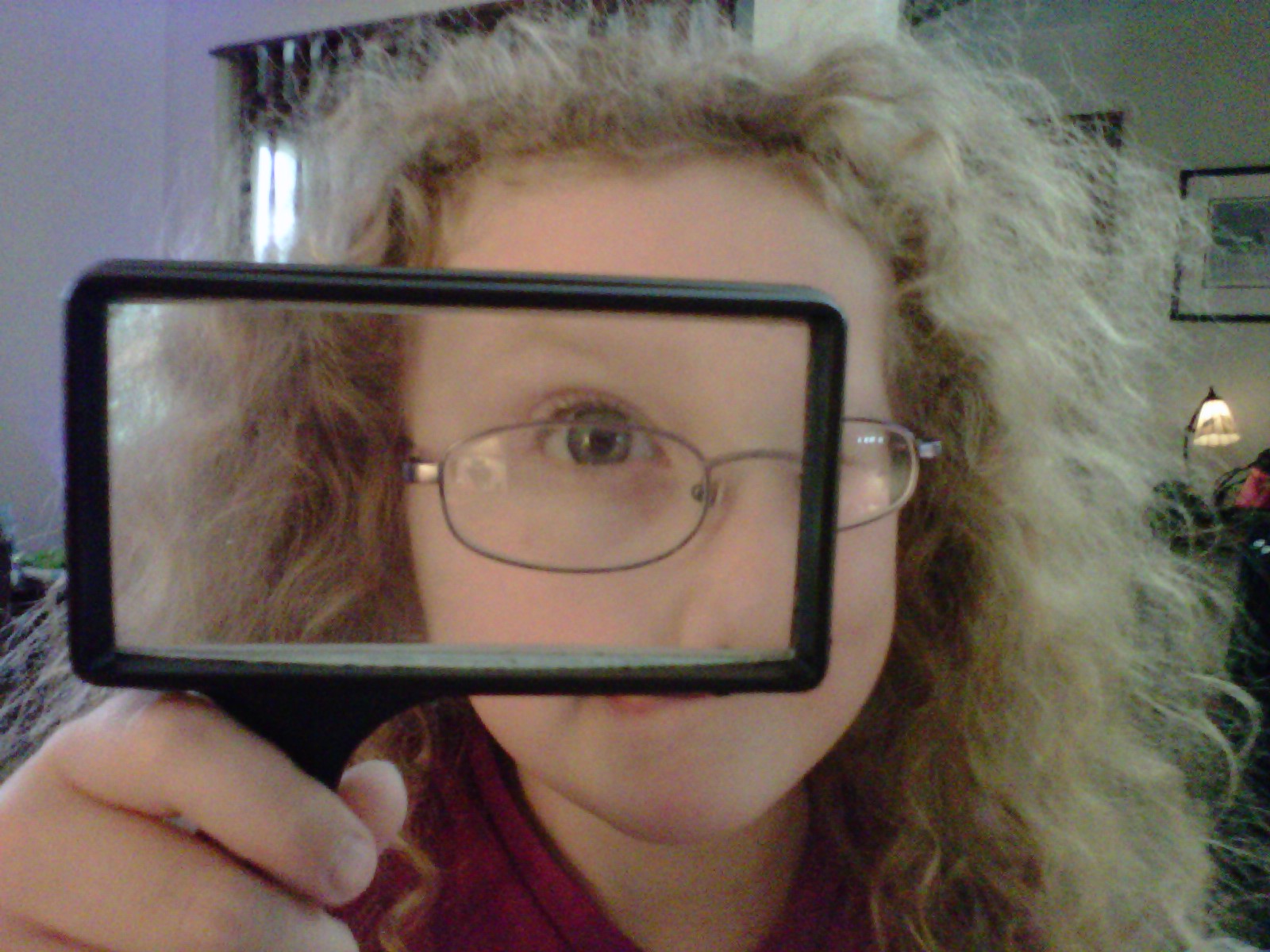
The cheaters got here.
 Now that I'm working the kickass librarian look, I will knit like the wind, get these sleeves done, and get this KAL moving. Sorry about the delay. I've already tried them, and I CAN see now, and they do work, so things will pick up soon.
Oh, and if it looks like my hair matches my glasses in that photo, it's because I dyed it this week. It was supposed to be purple, but really looks more like magenta. Oops. Colors get really unreliable when you put them over white hair, did you know that?
---
In other news, the Goobie celebrated her sixth birthday.
 I daily wonder how in hell I wound up with this, this KID roaming my house,
 but it's been a hell of a trip so far.
 I'm sure it'll just keep getting more interesting. I mostly can't wait. (The idea of her asking for car keys does fill me with a bit of terror, though.)
---
Last, least important, and most annoying, Sekhmet is on a diet.
 Since she was a stray, she associates food with security. During Hell Year I let her graze her head off, and never really cut her back after. Oops. So now I'm cutting her down to reasonable helpings of food. (She's also getting bacon, steak, cheese, and other table scraps in small quantities, so don't feel bad for her.)
 She's grown increasingly more irritated.
 The other night she woke me up at 3AM, by whopping me on the head.
Fucker.

Oh, and if it looks like my hair matches my glasses in that photo, it's because I dyed it this week. It was supposed to be purple, but really looks more like magenta. Oops. Colors get really unreliable when you put them over white hair, did you know that?
---
In other news, the Goobie celebrated her sixth birthday.


---
Last, least important, and most annoying, Sekhmet is on a diet.


Fucker.
Sunday, September 04, 2011
Why don't I spell it out.
Since apparently, some folks aren't getting it.
This is aimed (mostly) at knitting professionals. You know, the people you expect to KNOW STUFF. Say, producers of international magazines and publishers of lots of knitting books. The rest of you, well, I hope you find it interesting and educational, but since it's your hobby and not your JOB to know this stuff, well, it's your hobby, so enjoy.
First, COLOR KNITTING.
There are a bunch of different types of color knitting, but for now we're going to cover the two major types so I'm not here all freaking day (and neither are you). The two main types (not counting stripes or using types of variegated yarns, or slipped stitches, or...) are intarsia and stranded.
INTARSIA means "to insert" as in puzzle pieces, in Arabic. (I think Arabic.) The knitting term is swiped from a woodworking technique of the same name, in which pictures are made with little bits of different colored woods put together. That's basically what it is in knitting, but with fiber instead of wood. You knit little blobs of knitting, and twist the yarns together where the colors meet, to hold the little bits together. Generally, if a blob of color is more than an inch across, it's done with intarsia, because that's what it's best suited for. It gives you big blocks of color, like this:
 Kaffe Fassett is probably the most well known/notorious/insane(?) of designers who regularly use this technique, and this is his "Long Leaf Coat". For technique how-to, you can cruise over to Knitting Help to learn or jog your memory.
Then, there is STRANDED COLOR. It is just like it sounds like. You use two (or more) colors, and carry them along in strands across the back of the knitting, using whichever color you want to or feel like or the pattern says to do it. This is, historically, a popular method, because with all those strands running behind the main fabric, the thickness of the fabric doubles, at least. Which makes it much warmer. Because of all the strands running along behind, most folks don't knit with one color for more than an inch at a time, and usually try to stick with only two colors, for the sake of sanity. You wind up with smaller patterns, that often look like this:
 This happens to be Dale of Norway's Hafjell, knit by Yours Truly. (I'd have put up an example of my intarsia knitting, but I hate intarsia.)
So, get it? The two-color technique is called STRANDED COLOR. Anything knit with the other color running along the back, ANYTHING done with that TECHNIQUE, is called "stranded color".
FAIR ISLE IS A HISTORIC GROUP OF PATTERNS BASED IN THE NORTH SEA. They are knit WITH the stranded color technique, and are FAIR ISLE PATTERNED. The hallmark of the Fair Isle is an XOXOXO horizontal striping effect:
 See? Wait, why don't I help.
 Horizontal striping, XOXO within the stripe. More modern versions sometimes disguise the XO quite a bit with flowers and other pretties,
 and in this case, the X is the negative space, but if you look, it's there. (Also, look at the ribbing. That's called "corrugated ribbing" and is another design point for this traditional type of sweater.) Some folks get into arguments over whether some types of sweaters are really Fair Isle or not, because the islands in question have been influenced by many many other cultures over the years. But really, if you're getting strict about definition, you need an XO pattern for it to be Fair Isle. It might be beautiful and awesome, but it might not be a Fair Isle.
 Here's one we could argue over. I'm not sure if I consider it traditional or not, but I'm putting it here to give you an idea how hard it is to label some of the newer designs. And in the overall scheme of things, it doesn't matter a damn - it's a beautiful sweater and looks quite durable and warm, and that's what matters. But we're talking about correct labels here, so I'm trying to be, you know, correct. All above Fair Isle pictures are from the lovely book "The Art of Fair Isle Knitting" by the wonderfully skilled Ann Feitelson. If you're at all interested in traditional knitting, it is an excellent purchase and covers a great deal of history and color theory as well as having twenty-ish really nice, well written patterns.
Lusekofta ('lice coats' after the white flecks), or Setesdalen (after the valley of Setesdal where they were unvented) are ANOTHER type of traditional sweater also knit with the stranded color technique. They are very well known, so I'm including them in the retrospective.
 White on black, with most of the torso in white flecks. Often an XOX design, but not necessarily. VERY traditionally, the placket and collar of the cardigan or pullover are done with black felt, embroidered with lots of color, and held shut with pewter or silver (or other 'white' metal) clasps. This one is from Dale of Norway. Knit with stranded color. NOT A FAIR-ISLE. Get how this works? Now that you've seen it, you can look at the Hafjell I knit, above, and argue whether or not it's a "real" Lusekoft because it's blue, and because the pattern across the shoulders is quite big. But you can certainly see what the inspiration was.
BOHUS STICKNING is the name of a Swedish knitting co-op that's been out of business for decades. It is thought they developed the yoke sweater, to showcase their incredible color work, done with STRANDED COLOR:
 It is very likely that all yoke sweaters are descended from them, though it can't be proven at this late date. Not all of Bohus' sweaters were yoked, though. Some were all-over, some were just the fronts, or cuffs, etc. But they were known for their use of color, especially using purl stitches in a stockinette field to blend things:
 Some of their designers are still alive and enjoying some well-deserved fame. And there's a book out, with patterns and a history - "Poems of Color" by Wendy Keele. Sweater shown is the Blue Shimmer, pattern available in the book.
So there you go. By now you've probably got the idea why this stuff drives me crazy. Stranded color is the TECHNIQUE. Fair Isle is a specific folk style (that's pretty darn cool). Anyone who finds traditional folk styles interesting, you should look at "Knitting in the Old Way" by Priscilla A Gibson-Roberts and Deborah Robson. They discuss all this in great detail, and lots besides, as well as tweaking the EPS into doing all sorts of amazing things.
This is aimed (mostly) at knitting professionals. You know, the people you expect to KNOW STUFF. Say, producers of international magazines and publishers of lots of knitting books. The rest of you, well, I hope you find it interesting and educational, but since it's your hobby and not your JOB to know this stuff, well, it's your hobby, so enjoy.
First, COLOR KNITTING.
There are a bunch of different types of color knitting, but for now we're going to cover the two major types so I'm not here all freaking day (and neither are you). The two main types (not counting stripes or using types of variegated yarns, or slipped stitches, or...) are intarsia and stranded.
INTARSIA means "to insert" as in puzzle pieces, in Arabic. (I think Arabic.) The knitting term is swiped from a woodworking technique of the same name, in which pictures are made with little bits of different colored woods put together. That's basically what it is in knitting, but with fiber instead of wood. You knit little blobs of knitting, and twist the yarns together where the colors meet, to hold the little bits together. Generally, if a blob of color is more than an inch across, it's done with intarsia, because that's what it's best suited for. It gives you big blocks of color, like this:

Then, there is STRANDED COLOR. It is just like it sounds like. You use two (or more) colors, and carry them along in strands across the back of the knitting, using whichever color you want to or feel like or the pattern says to do it. This is, historically, a popular method, because with all those strands running behind the main fabric, the thickness of the fabric doubles, at least. Which makes it much warmer. Because of all the strands running along behind, most folks don't knit with one color for more than an inch at a time, and usually try to stick with only two colors, for the sake of sanity. You wind up with smaller patterns, that often look like this:

So, get it? The two-color technique is called STRANDED COLOR. Anything knit with the other color running along the back, ANYTHING done with that TECHNIQUE, is called "stranded color".
FAIR ISLE IS A HISTORIC GROUP OF PATTERNS BASED IN THE NORTH SEA. They are knit WITH the stranded color technique, and are FAIR ISLE PATTERNED. The hallmark of the Fair Isle is an XOXOXO horizontal striping effect:


Lusekofta ('lice coats' after the white flecks), or Setesdalen (after the valley of Setesdal where they were unvented) are ANOTHER type of traditional sweater also knit with the stranded color technique. They are very well known, so I'm including them in the retrospective.

BOHUS STICKNING is the name of a Swedish knitting co-op that's been out of business for decades. It is thought they developed the yoke sweater, to showcase their incredible color work, done with STRANDED COLOR:


So there you go. By now you've probably got the idea why this stuff drives me crazy. Stranded color is the TECHNIQUE. Fair Isle is a specific folk style (that's pretty darn cool). Anyone who finds traditional folk styles interesting, you should look at "Knitting in the Old Way" by Priscilla A Gibson-Roberts and Deborah Robson. They discuss all this in great detail, and lots besides, as well as tweaking the EPS into doing all sorts of amazing things.
Friday, September 02, 2011
Vogue Knitting, fall 2011
It's that time. Actually, past that time. Had trouble getting motivated. As usual, photos are from the magazine or web site, quotes the same, all else is mine. (Also, I've figured out a way to do the review without breaking my momentum, which means a longer review... both good and bad, I guess. If you're here for just the patterns, scroll on down. They're here.)
For those who think I get off on criticizing people, guess again. I actually feel kind of bad about some stuff in this issue. But my job, as I see it, is to save KNITTERS time and frustration (and money). And some of this stuff has to be pointed out, if I'm going to do that. A great deal of this stuff is fine (other than crappy size selection), but most can be improved with an eye toward fit and optical illusion.
So, the magazine. The usual advertising-as-article. Rowan's making a new bulky yarn, may the gods save us. Plymouth is pushing matching his and hers sweaters - again I appeal to the gods.
There's a free pattern available on the web site (somewhere unmarked) that's a knock off of the white angora cardigan that Kate Middleton/Princess Kate wore during her wedding. I'd tell you if it was free to all or just free to those with a magazine, but, uh, I can't find it.
A page of knitting art that's kind of cute; I may need to get some for the living room.
Trendsetter Yarns is advertising Big Fuzzy Things.
The weather gets cold, and people start knitting super-bulky. I could cry tears of blood.
The 'new yarns' section is balls of stuff. AGAIN. No gauge swatches, AGAIN. Fuckers. Anyway, it's about 'chainette' yarns, the ones that are basically loosely-knit I-cord. Considering that Clara Parkes' all time favorite yarn is said to be one of these, in cashmere, they may be worth trying out. They aren't cheap, though; think scarf, not coat, no matter what VK tells you. Debbie Bliss is doing one in alpaca/merino; Lana Grossa has one in wool/silk/poly, and Rowan has one in 98% alpaca with enough poly to hold it together. HELLO, HEAT STROKE!
Ad with Maryilyn Monroe's hair photoshopped to wool. Creepy.
Franklin (Habit) interviews the winner of last issue's mohair contest. No idea why it wasn't in the LAST issue, but he's always interesting.
"News" is pushing a Nicky Epstein book from 2008. Some woman is knitting her way through it. I wish her luck with that. Sincerely.
Signature Needles is making circulars now, short and long.
UNICORN BOOKS IS PUBLISHING ANOTHER COLLECTION OF NORWEGIAN PATTERNS. "Norwegian Knitting Designs: A Collection From Norway's Foremost Knitting Designers" by Margaretha Finseth. MUST HAVE! Wait. It's a reprint from 2002. How very helpful for VK to leave that out. Anyway, if you didn't get Norsk Strikkedesign in 2002, now's your chance. (I love my copy. Just saying.)
Spotlight discusses the new "Principles of Knitting" and INSISTS that it's coming out this year. I hold not my breath, but I would like to give a copy to my MIL for Christmas.
Meg Swansen writes about how to do short rows. Three different methods; Barbara Walker, Yarn Over Method, and Japanese Method. Being cool, Meg also credits who taught them to her.
Technique is with Nancy Marchant, who shows how to do two-color cables in brioche knit. A brain-bender, but very cool. Have you bought her book yet? No? Why not?
The "Special Advertising Section" has a free sock patterns available on line at VK, from Kollage yarns, Alpaca with a Twist, Mountain Colors, Simply Socks, and Tilli Thomas. "Download this free pattern at vogueknitting.com" what, they couldn't bother to set up the actual pages and PRINT THE EXACT URL to make the patterns easy to find? Sheer laziness and bad planning. (Let me know if y'all find 'em.) There's also a free cardigan pattern from Classic Elite. This one's actually on paper. Y'know, so you can find it.
And then, the patterns.
Section one is "Masterpiece Classics". When I read the word "classic" in regard to knitting, I think of classic FASHION knitting, as in stuff created since 1920ish that's really iconic. Not FOLK KNITTING, which is a whole other category - and all the stuff in this section. Don't get me wrong. I love folk knitting. Most of what I do is considered folk knitting. I think it's timeless and produces sweaters you can wear until they fall apart, so there's not a thing wrong with it. BUT IT ISN'T FASHION. For folk knitting to cross over to fashion, it needs to be adapted in some way. In other words, "inspired by", not "a copy of". The majority of stuff in this section is plain old Folk Knitting, so again I wonder why in hell VK calls it fashion. But the few fashion bits they've got are pretty cool. This sort of thing, along with weird and/or dumb names and mis-labeled techniques, is not the fault of the designers, who have nothing to do with how the magazine is put together (or how their designs are modeled); it is on the heads of the editors, who should REALLY know better, particularly if they knit. (Allegedly. I hold not my breath.)
1. Nordic Gloves by Lone Smevik Soleng (apologies if I got the name wrong).
 One size, measured by hand circumference and length. They ARE Nordic, and are called such in the title, but the blurb on the page calls it a "Fair Isle snowflake". Methinks the editors need to TALK TO EACH OTHER. Or PAY THE FUCK ATTENTION. Or both. Photographed in such a way, I've got to look at the schematics to know if they're mittens or gloves. And I'm so used to VK fucking up the names of things, I can't trust the title “Nordic Gloves” to actually mean gloves. But they do, and they are. Want a high-fashion pair of gloves that look like something knit 200 years ago? Here you go. HUSBEAST: "What, is she fainting, her hair is so bad? Or is it because the cat around her neck farted?"
2. Squirrel Cardigan by Yoko Hatta. Again with the term "Fair Isle" in the page blurb. SERIOUSLY, VK? SERIOUSLY?
 Four sizes from 36 to 48 inches/92 to 122 cm. Knit with alpaca, so really better suited to the winter edition. Ask me, the squirrels would look better across the shoulders, give a more flattering line, and you wouldn't have to worry about having wild animals hanging on your ass if the fit goes a little wrong. Hey. It's possible. Oh – those of you worried about plagiarism because there's an identical sweater from a Japanese knitting mag? No sweat. Same designer, slightly different gauge, AND A STUNNINGLY ORIGINAL PATTERN FOR VK! (Thanks to my readers who directed me to the copyright issue over on Ravelry.)
3. Nordic Cardigan by Shiri Mor.
 Two sizes. 32 and 36 inches/81 and 91 cm. They are calling a 36 inch bust a size medium. FUCK YOU, VOGUE. “A modern take on the timeless XO motif”. NO. IT IS A TAKE ON THE NOT-MODERN NORWEGIAN LUSTKOFE, MOTHERFUCKERS. Thank you, VK copy writers, for fucking up AGAIN. (“Everyone here knits”, my ass.) As part of the modern take, there is actual FITTING. Take a look: See the darts, to add waist shaping?
 Yup. A lustkofe that's flattering. Impressive. (That's harder to pull off than you might think, given the originals.) Unfortunately, 36 inches in a cardigan meant to go over other clothing means very few people - even fit, "thin" people - can wear it.
4. Oversize[d] Nordic Pull by Kristen Nicholas.
 Five sizes from 38 to 53 inches/96 to 136 inches. THIS. This is just appalling. No effort whatsoever was made to match up the diamond patterns on the shoulders. NONE. What's really pathetic is, it's easily solved! All you do is pick up the sleeve at the shoulder, in pattern, then knit downward to the wrist. It was pioneered by EZ and her daughter Meg years ago, in the Russian Prime. And since Meg writes for VK they could have done a technique article tie-in, and made things really helpful. OH YEAH. BUT THEY DIDN'T. While I'm ranting, have a look at this:
 Okay. Red circles are obviously where the shoulder seams don't match up. (SERIOUSLY?) Now let's take a look at how this hangs. See the yellow lines? Yup. It's an A line, on purpose or accident, and in and of itself, A lines are okay. Except then the horizontal pattern is put on at the hips, creating an optical illusion making them seem even wider, which they already are due to the A line. Um. NO. HUSBEAST: "God, I thought that was her butt in front. It's camouflaged, apparently."
5. Colorwork Vest by Cheryl Murray.
 Five boxy sizes from 40 to 52 inches/101 to 133 cm. Steeked alpaca (??!??), so make sure you use a sewing machine or hand sew very closely, to hold the cut stitches. Also more appropriate to the winter issue. If it's a 'colorwork' vest, WHERE'S THE COLOR? Seriously? Anyway, this is a take on a North Sea style, the precursor to Fair-Isles. Before synthetic dyes existed (1860s, ish), they used the natural colors of their sheep. You'd get things like this as a result. Except the zipper's new. Those have only been around, what, a hundred years?
6. Snowflake Jacket by Yoko Hatta.
 Four sizes from 36 to 48 inches/91 to 122 cm. A yarn company special; one yarn is discontinued, but to knit the medium size without the carry-along is $423 USD. Ha. I will never get this type of fashion. If it's cold enough to warrant a long coat/cardigan thing, with a big collar, why then, does it have short sleeves?
7. Nordic Yoke Pullover by Ruth Garcia-Alcantud.
 Four sizes from 31 to 37 inches (really? REALLY?)/78 to 94 cm. Yet another sweater that fails to take into account the difference between regular stockinette and stranded color. I don't know if the idea was for the sweater to be super-tight across the shoulders ('cause it is) to hold it up, or if that was just an, um, accidental design element. Possibly it's because of who they chose to model it.
 But it looks like crap on the model, from the back. Whatever else there is to say, that is DEFINITELY not a proper fit. Also, stylist, what in HELL is up with the hair??!
8. Fair Isle Hat by Mary Ann Stephens.
 One size, 20 inches/51 cm. Adorable. According to my books, Scandinavia and the North Sea islanders were producing hats like this for 150 years. There's a lithograph from 1857 with a hat just like this depicted.
9. Fair Isle Cardigan by Rosemary Drysdale.
 Five sizes from 34 to 56 inches/87 to 143 cm. Another copy of old styles, rather than an adaptation. Unless you count only doing the color work on the front an adaptation of style. “...fetching Fair Isle cardigan”. IT IS NORWEGIAN. IT HAS SOMETHING CALLED A NORWEGIAN FUCKING STAR ON IT. IT HAS LICE KNIT IN. GET WITH IT VK, FOR CRYING OUT LOUD. YOU LOOK LIKE IDIOTS. (I know I keep harping on it. But this mis-labeling makes VK look really, really, REALLY bad.) Also, check out the hand-on-hip to make it look like it's got a waist. It doesn't.
Section two. (Please no more mislabeled folk knitting, my heart can't take it.) "The New Trend; Captivating twists pop against a field knit in the comeback color of the season". Please note, this 'comeback color' makes most of the population look like shit. The model is a striking woman with the best coloring possible to wear this lime green, and SHE doesn't really look good in it. So, you know... be ware.
10. Cable Raglan Dress by Sarah Hatton.
 Note they don't show the whole body, anywhere. Ha. THAT'S a good sign, all right. Four sizes from 35 to 39 inches/89 to 100 cm. It doesn't even look good on the model. Shorten it and wear it as a pullover.
 Also: Arm trick!
11. Cabled Cardigan by Mari Tobita.
 For the love of all that's holy, KNIT THIS THING IN A DIFFERENT COLOR! Five sizes from 34 to 48 inches/86 to 122 cm. If I had the time, I'd knit this one for myself. In, you know, another color. This one's pretty cool. The lace panel in the middle kind of stretches and creates an optical illusion of an hourglass figure that makes the person wearing it look slimmer and curvy. See? (Blue lines.)
 The way the sleeves are set in, though (red circle), you're gonna need the finishing skills of a god to make it look as good as this sample does. The collar is picked up in pattern and knit on after... finshing skills of a god, I tell ya. But if you CAN pull it off, it's definitely one of the best choices in the issue. In another color.
12. Cabled Shrug by Devin Cole.
 Three sizes from 38 to 43 inches/96 to 109 cm. Which is too bad, 'cause big-busted women look good in styles that define the waist. Like this. Fuckers. Mmmm, pooled blobs of color. BEWARE THE VARIEGATED YARNS, PEOPLE! I'm assuming VK demanded this yarn be used (Prism, high cost, $160 USD for size medium.). In a solid color, it'd be a nice pullover. But the way that neck is set in? You're back to needing a god of finishing skills. Interestingly, they don't show the neck in the picture (shock!) but the ribbing meets sideways reverse stockinette RIGHT SLAP IN THE MIDDLE OF THE CHEST, so do it right or not at all.
13. Wave Cable Jacket by Ellen Liguori.
 Four sizes from 40 to 55 inches/101 to 141 cm. Finally! Someone sizes a coat properly! Kinda cute fuzzy coat-jacket-thingie. “...provide a cool backdrop for graphic cabling.” HAHAHA. In the magazine, you can't even SEE the cables, for all the busy yarn, between fluff and shifting color. I had to look at the pattern to be sure the cables were THERE. REALLY well planned pattern/yarn choice combination, right here. Make a note under “what not to do”. Knit with a less busy and fluffy yarn, it looks like a nice pattern for a light jacket. (In these situations I assume VK dictated yarn choice, 'cause designers should really know better.)
14. Ribbon Cable Cardi by Helen Sharp.
 Four sizes from 34 to 47 inches/86 to 119 cm. Rather run of the mill cardigan with ribbon strung through the holes in the cables. The collar. THE COLLAR. What the hell is that, a giant snap the size of a pocket watch? Or is it some kind of brooch? I can't tell. Wut de heww? Also: CODE RED ON THE RIBBON. The pattern calls for WIRED ribbon. (Ribbon with wire in the edges.) DO NOT USE. I'm something of a ribbon expert, due to crazy stuff like this... Wired ribbon is nearly impossible to straighten out again, once it gets bent. So the first time you fold this sweater? You've permanently fucked up the ribbons. Use regular, it'll be fine. If you fall in love with a wired ribbon, that's okay: get a pair of pliers and pull out the wires and you're good to go. HUSBEAST: "WIRED ribbon? Bitch, please. Do you want Dracula's collar or some shit?"
15. Ribbed Turtleneck by Pat Olski.
 Four sizes from 30 to 39 inches/85 to 99 cm. What. WHAT. WHAT??!!?? is that tie thingie doing on the side of that sweater? WHAT??!?!?!?! It's like someone knit a perfectly nice turtleneck with an asymmetric cable, and then stuck some dumbass bow on the side for some crazed reason. WHYYYY?!?!?! No one try to explain that bow as fashion. FASHION IS NOT DORKY-LOOKING. Leave the bow off. If you can fit into it, it's a great sweater.
And our next section, my eternal favorite, the super bulky designer WTF section! "Bold bands of color invigorate that unmistakable Twinkle Silhouette." Oh, suuuuure. You betcha. HUSBEAST: "That's some bulky-ass shit. Is that for wearing around the house, is that what that is? It's gotta be. Plus size? HORIZONTAL STRIPES. That doesn't make sense."
16. Striped Cardi by Twinkle.
 Sizes. Ha, it comes in sizes. Three sizes from 54 to 62 inches/137 to 157 cm. “Everything about Twinkle's short-sleeved cardi is oversized...” SO WHY ARE YOU GOING TO HANG IT ON YOURSELF? It makes the model look like a heifer! Also, this sucker is knit with SUPER bulky yarn. WHYYYY do you want to wear something called “SUPER BULKY”???? Wait. Wait.
 THERE YA GO. Oh, and $124 USD for the size medium. HOOK ME UP.
17. Striped Back Top by, yes, Twinkle.
 Three sizes from 40 to 48 inches/101 to 122 cm. More of the same. Another super-bulky monster. Want carpal tunnel? Knit with this stuff. Six stitches to four inches/ten centimeters. $150 USD for medium. THERE SHOULD BE A LAW. Oh, and want to make yourself batshit crazy? Knit this. There are different gauges for the front and back. Oh, won't THAT be a joy to join together. Because seaming super-bulky is so easy WITHOUT a gauge difference. Seriously, Twinkle? SERIOUSLY?
Section, uh, three? Four? Next. Section next. "The Art of Lace." Blah, blah, blah. Giant portrait of Marie Antoinette looming over the photo shoot; not sure that's quite the way they wanna go, historically speaking. Then again, VK doesn't seem to know KNITTING history, so, why am I surprised? LET ME EAT CAKE, BITCHES. (Do not bother telling me that quote wasn't historically correct. What do you see around here that's historically correct? Hey. Is that a cupcake?)
18. Lace Cardi and Cowl, by E J Slayton.

 Five sizes from 36 to 52 inches/92 to 133 cm. I really don't get this new concept of knitting a perfectly good cardigan and plopping a cowl on top of it and calling it sophisticated. It's not. It's a cowl on top of a cardigan. Anyway, it's nice enough. A-line, knit with sock yarn so it's a transitional weather piece. The lace pattern itself is easy too. If you want a beginner lace garment, this one's a nice choice.
19. Lace Turtleneck by Jenifer Stark.
 Three sizes from 31 to 43 inches/80 to 109 cm. HOTTER THAN A SUMMER IN HELL. Two layers of knitting, one of them mohair. If you live somewhere that gets cold, then yeah, go for it. But, damn. HOT. Also, it's TWO SWEATERS, which will obviously take TWICE AS LONG. And also cost, well, twice as much? $184 USD for the size medium. But, still. Nice if that's what you're looking for. (HOT.) HUSBEAST: "What's wrong with this? She's twisted all out of shape." Nothing, she's just posed that way for some unaccountable reason.
20. Lace Bodice Top by Laura Zukaite.
 Three sizes, measured at lower edge which makes no sense to me. Silk/cashmere blend. No tensile strength, so a tunic will grow to a dress while giving you heat stroke. I assume this is another Yarn Company Special. $245 USD for size medium. Economy? What economy?
21. Lace Shawl by Candace Eisner Strick.
 Width along top edge, 52 inches/132 cm. If you want a lace shawl, this is a nice one. It's even got some fitting to it, so it will stay on your shoulders better than some. Do I need to editorialize on how long knitted shawls have been around, and how non-fashion they are? No, I didn't think so. It's a nice shawl. If you wear them, you could do a lot worse.
Section next to last! YAY! "All About Ease" Knit these timeless fashions to look utterly boxy and waistless. No. Wait. "Unwind in generously sized toppers that give you room to breathe." Am I the only one who thinks "topper" sounds like a dominatrix? Yes? Okay then!
22. Bulky Topper (HA! A plus sized dominatrix?) by Mari Lynn Patrick.
 Five sizes from 35 to 44 inches/90 to 113 cm. Hot damn, once again the Boobs of Doom work in my favor! Oh yes, kangaroo pockets. SO FLATTERING. DOUBLE layers of fabric over your gut! What could possibly go wrong? “Casual charm” my ass. Awesome necklace, though.
23. Cowl Neck Pullover by Maie Landra.

 Five sizes from 40 to 53 inches/101 to 141 cm. Slightly schizophrenic pullover... is it a tunic? Is it a turtleneck? Is it multi-color or solid? I do like the idea of knitting with two strands of Koigu for color variation, but that isn't gonna be cheap. In fact, $478 USD for the next-to-largest size. DUDE. Holy SHIT. SERIOUSLY? IT DOESN'T EVEN HAVE SLEEVES!
24. Lace Belted Cape by Kristen Omdahl.
 One size, 80 inches/203 cm. A poncho with a belt, so you can't raise your arms. Uh huh. I don't... just... WHAT??!!??
25. Rib Yoke Topper [insert your choice of dominatrix joke here] by Anna Cohen.
 Five sizes from 48 to 56 inches/122 to 143 cm. Another schizo sweater. It's like they started knitting a businesslike pullover with the tuxedo shirt front sort of thing that's kind of cute (but needs better increasing around the edges). Then they got bored and slapped some short sleeves on it that stick out like wings:
 and don't 'fit' the rest of the sweater. In fact, they don't fit at all, style or actual size.
26. FUN FUR COWL, BABY! by Vladmir Teriokhin.
 Size... you know, fuck it. No one cares. No one's gonna make this thing. A FUN FUR COWL. In Vogue Knitting. In 2011. Oh no, NOT OUT OF TOUCH WITH KNITTERS AT ALL. Not a bit. ARE YOU FUCKING KIDDING ME??!!?? Oh, wait. It's crocheted. THAT'S TOTALLY DIFFERENT. (I kid, I kid. No one hook my brain out my nose.)
27. Jacket by Vladmir Teriokhin.
 "Very oversized" three sizes from 52 to 60 inches/132 to 152 cm. At least the man knows how to size a freakin' coat. You could actually WEAR IT OVER OTHER STUFF. Unfortunately, that's about the best that can be said. It doesn't fit right. It buttons over the shoulder, oddly, and results in no waist at all. And there are double – triple?? - layer pockets adding bulk to the hips, which, you know, ALL WOMEN LOVE THAT. Plus, that eternal question, IF IT'S MEANT AS A JACKET, WHERE IN HELL ARE THE SLEEVES?
28. Cropped Topper (HA! Short dominatrix!) by Faith Hale.
 Three sizes from 38 to 46 inches/96 to 116 cm. It is what it is, which is a really casual, bulky short-sleeved jacket. One of the yarns is named Vagina? Wait, what??!? Hang on...
 There. Is that REALLY what you want to look like, from behind?
SECTION LAST! HOT FUCKIN' DAMN! "What you want NOW!" Allegedly fast knits for allegedly instant gratification. "Knitterly [WTF?!] enough to hold your interest, small enough to wear almost instantly." Some of these WOULD make nice gifts. And at least everything isn't freakin' red again.
29. Hooded Neck Piece by Kalurah Hudson.
 One size by neck circumference. I can see the usefulness of a hood separate from a jacket; you can add it on to anything, when you need it, in changeable weather. What I can't see is the fashion, high or otherwise. I'd use fewer buttons so they didn't bunch up and stick out in front. Just sayin'.
30. Lace Scarf by Carol Sulcoski.
 Someone knit a scarf with lace patterns from a Barbara Walker book. Did they get PAID for this?
31. Textured Hat by Simona Merchant-Dest.
 Stocking cap. Yup. Useful. Nope, not fashion.
32. Fingerless Gloves by Judy Sumner.
 Fingerless gloves. Am I the only one thinking we've hit market saturation for these types of patterns? It's like rectangular mohair lace wraps, a few years ago. Had enough, thanks!
33. Leaf Mittens by Pat Olski.
 Mittens. Yup. They're mittens, all right.
34. Lace Scarf by Nancy MacMillan.
 Another Barbara Walker Special. Pretty sure that central pattern is Chinese Lace from book three, but I'm not looking it up. It's late and I'm wishing for vodka. I'm damn tempted to look up the patterns, chart them, and offer them for free, but I don't need the bullshit copyright headaches it will lead to. (Someone paid Barbara Walker a percentage, right? RIGHT?)
35. I-Cord Gloves by (ha) Karen Kendrick-Hands. Ha.
 Gloves. Is it me, or do those look weirdly, oddly bulky? Or is it just that she's wearing really light sleeves?
36. Cabled Leg Warmers by Yoko Hatta.
 Fitted leg warmers. Or footless socks. Or. Um. Something.
37. Braided Cowl by Laura Zukaite.
 Interesting cowl-capelet thing. It would be nice to wear with a coat, to fill in the neck and keep you warm. It's got really unusual construction, though, and given VK's track record with errata, KNIT WITH EXTREME CAUTION. Too bad, 'cause this one's kind of cool and potentially useful. Maybe one of these days VK will hire someone to actually pay attention to errata and I won't have to worry about this stuff, and neither will you.
That's it. Stick a fork in me, 'cause I am DONE. Until next time, knit wisely.
For those who think I get off on criticizing people, guess again. I actually feel kind of bad about some stuff in this issue. But my job, as I see it, is to save KNITTERS time and frustration (and money). And some of this stuff has to be pointed out, if I'm going to do that. A great deal of this stuff is fine (other than crappy size selection), but most can be improved with an eye toward fit and optical illusion.
So, the magazine. The usual advertising-as-article. Rowan's making a new bulky yarn, may the gods save us. Plymouth is pushing matching his and hers sweaters - again I appeal to the gods.
There's a free pattern available on the web site (somewhere unmarked) that's a knock off of the white angora cardigan that Kate Middleton/Princess Kate wore during her wedding. I'd tell you if it was free to all or just free to those with a magazine, but, uh, I can't find it.
A page of knitting art that's kind of cute; I may need to get some for the living room.
Trendsetter Yarns is advertising Big Fuzzy Things.
The weather gets cold, and people start knitting super-bulky. I could cry tears of blood.
The 'new yarns' section is balls of stuff. AGAIN. No gauge swatches, AGAIN. Fuckers. Anyway, it's about 'chainette' yarns, the ones that are basically loosely-knit I-cord. Considering that Clara Parkes' all time favorite yarn is said to be one of these, in cashmere, they may be worth trying out. They aren't cheap, though; think scarf, not coat, no matter what VK tells you. Debbie Bliss is doing one in alpaca/merino; Lana Grossa has one in wool/silk/poly, and Rowan has one in 98% alpaca with enough poly to hold it together. HELLO, HEAT STROKE!
Ad with Maryilyn Monroe's hair photoshopped to wool. Creepy.
Franklin (Habit) interviews the winner of last issue's mohair contest. No idea why it wasn't in the LAST issue, but he's always interesting.
"News" is pushing a Nicky Epstein book from 2008. Some woman is knitting her way through it. I wish her luck with that. Sincerely.
Signature Needles is making circulars now, short and long.
UNICORN BOOKS IS PUBLISHING ANOTHER COLLECTION OF NORWEGIAN PATTERNS. "Norwegian Knitting Designs: A Collection From Norway's Foremost Knitting Designers" by Margaretha Finseth. MUST HAVE! Wait. It's a reprint from 2002. How very helpful for VK to leave that out. Anyway, if you didn't get Norsk Strikkedesign in 2002, now's your chance. (I love my copy. Just saying.)
Spotlight discusses the new "Principles of Knitting" and INSISTS that it's coming out this year. I hold not my breath, but I would like to give a copy to my MIL for Christmas.
Meg Swansen writes about how to do short rows. Three different methods; Barbara Walker, Yarn Over Method, and Japanese Method. Being cool, Meg also credits who taught them to her.
Technique is with Nancy Marchant, who shows how to do two-color cables in brioche knit. A brain-bender, but very cool. Have you bought her book yet? No? Why not?
The "Special Advertising Section" has a free sock patterns available on line at VK, from Kollage yarns, Alpaca with a Twist, Mountain Colors, Simply Socks, and Tilli Thomas. "Download this free pattern at vogueknitting.com" what, they couldn't bother to set up the actual pages and PRINT THE EXACT URL to make the patterns easy to find? Sheer laziness and bad planning. (Let me know if y'all find 'em.) There's also a free cardigan pattern from Classic Elite. This one's actually on paper. Y'know, so you can find it.
And then, the patterns.
Section one is "Masterpiece Classics". When I read the word "classic" in regard to knitting, I think of classic FASHION knitting, as in stuff created since 1920ish that's really iconic. Not FOLK KNITTING, which is a whole other category - and all the stuff in this section. Don't get me wrong. I love folk knitting. Most of what I do is considered folk knitting. I think it's timeless and produces sweaters you can wear until they fall apart, so there's not a thing wrong with it. BUT IT ISN'T FASHION. For folk knitting to cross over to fashion, it needs to be adapted in some way. In other words, "inspired by", not "a copy of". The majority of stuff in this section is plain old Folk Knitting, so again I wonder why in hell VK calls it fashion. But the few fashion bits they've got are pretty cool. This sort of thing, along with weird and/or dumb names and mis-labeled techniques, is not the fault of the designers, who have nothing to do with how the magazine is put together (or how their designs are modeled); it is on the heads of the editors, who should REALLY know better, particularly if they knit. (Allegedly. I hold not my breath.)
1. Nordic Gloves by Lone Smevik Soleng (apologies if I got the name wrong).

2. Squirrel Cardigan by Yoko Hatta. Again with the term "Fair Isle" in the page blurb. SERIOUSLY, VK? SERIOUSLY?

3. Nordic Cardigan by Shiri Mor.


4. Oversize[d] Nordic Pull by Kristen Nicholas.


5. Colorwork Vest by Cheryl Murray.

6. Snowflake Jacket by Yoko Hatta.

7. Nordic Yoke Pullover by Ruth Garcia-Alcantud.


8. Fair Isle Hat by Mary Ann Stephens.

9. Fair Isle Cardigan by Rosemary Drysdale.

Section two. (Please no more mislabeled folk knitting, my heart can't take it.) "The New Trend; Captivating twists pop against a field knit in the comeback color of the season". Please note, this 'comeback color' makes most of the population look like shit. The model is a striking woman with the best coloring possible to wear this lime green, and SHE doesn't really look good in it. So, you know... be ware.
10. Cable Raglan Dress by Sarah Hatton.


11. Cabled Cardigan by Mari Tobita.


12. Cabled Shrug by Devin Cole.

13. Wave Cable Jacket by Ellen Liguori.

14. Ribbon Cable Cardi by Helen Sharp.

15. Ribbed Turtleneck by Pat Olski.

And our next section, my eternal favorite, the super bulky designer WTF section! "Bold bands of color invigorate that unmistakable Twinkle Silhouette." Oh, suuuuure. You betcha. HUSBEAST: "That's some bulky-ass shit. Is that for wearing around the house, is that what that is? It's gotta be. Plus size? HORIZONTAL STRIPES. That doesn't make sense."
16. Striped Cardi by Twinkle.


17. Striped Back Top by, yes, Twinkle.

Section, uh, three? Four? Next. Section next. "The Art of Lace." Blah, blah, blah. Giant portrait of Marie Antoinette looming over the photo shoot; not sure that's quite the way they wanna go, historically speaking. Then again, VK doesn't seem to know KNITTING history, so, why am I surprised? LET ME EAT CAKE, BITCHES. (Do not bother telling me that quote wasn't historically correct. What do you see around here that's historically correct? Hey. Is that a cupcake?)
18. Lace Cardi and Cowl, by E J Slayton.


19. Lace Turtleneck by Jenifer Stark.

20. Lace Bodice Top by Laura Zukaite.

21. Lace Shawl by Candace Eisner Strick.

Section next to last! YAY! "All About Ease" Knit these timeless fashions to look utterly boxy and waistless. No. Wait. "Unwind in generously sized toppers that give you room to breathe." Am I the only one who thinks "topper" sounds like a dominatrix? Yes? Okay then!
22. Bulky Topper (HA! A plus sized dominatrix?) by Mari Lynn Patrick.

23. Cowl Neck Pullover by Maie Landra.


24. Lace Belted Cape by Kristen Omdahl.

25. Rib Yoke Topper [insert your choice of dominatrix joke here] by Anna Cohen.


26. FUN FUR COWL, BABY! by Vladmir Teriokhin.

27. Jacket by Vladmir Teriokhin.

28. Cropped Topper (HA! Short dominatrix!) by Faith Hale.


SECTION LAST! HOT FUCKIN' DAMN! "What you want NOW!" Allegedly fast knits for allegedly instant gratification. "Knitterly [WTF?!] enough to hold your interest, small enough to wear almost instantly." Some of these WOULD make nice gifts. And at least everything isn't freakin' red again.
29. Hooded Neck Piece by Kalurah Hudson.
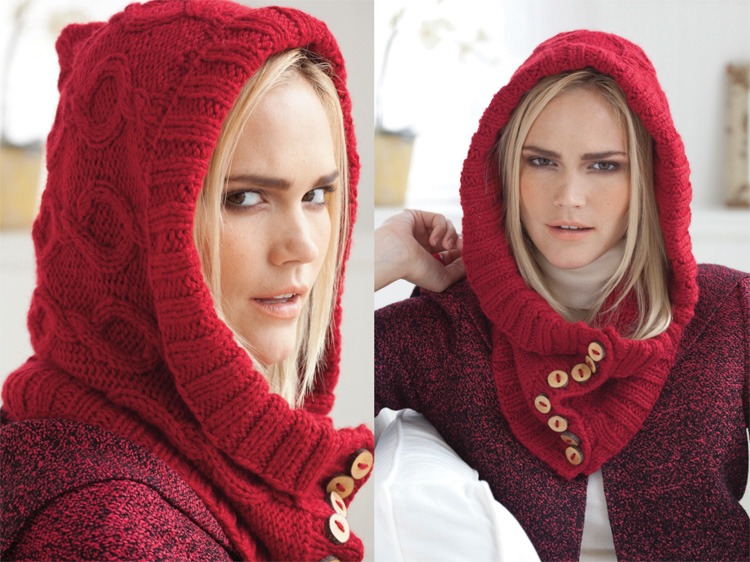
30. Lace Scarf by Carol Sulcoski.

31. Textured Hat by Simona Merchant-Dest.

32. Fingerless Gloves by Judy Sumner.

33. Leaf Mittens by Pat Olski.

34. Lace Scarf by Nancy MacMillan.

35. I-Cord Gloves by (ha) Karen Kendrick-Hands. Ha.

36. Cabled Leg Warmers by Yoko Hatta.

37. Braided Cowl by Laura Zukaite.

That's it. Stick a fork in me, 'cause I am DONE. Until next time, knit wisely.
Subscribe to:
Posts (Atom)