Wednesday, March 09, 2011

Of big butts and waist shaping.

With another Vogue Knitting review looming, I decided to take a day and explain a BIT of my design, um, philosophy? That's a fancy word for it. What I'm thinking when I do these reviews. Because I do tend to harp on some subjects more than I would, otherwise. I've said it before, but it probably bears repeating. I don't analyze these according to what I LIKE. I discuss them with an idealized 'average woman' (both in size and age and coloring) in mind. What, of the choices, would suit? Why? How hard would it be to knit? That sort of thing. What I like rarely coincides with that, and that's okay.

Generally, I separate knitted clothing into two broad categories: casual and dressy. Casual knits? The foundation and history of knitting. Looks are secondary to function. Keep warm, be comfortable, and get stuff done, those are the priorities there. Dressy? While I still think function should be a factor, looking good becomes much more of a priority.

That said, I consider everything in Vogue Knitting 'dressy knits', or they SHOULD be. If you're spending $250 on silk yarn to knit a cardigan, then yes, looking good damn well ought to be on the menu. I don't expect it to make anyone look fifty pounds lighter or six inches taller, but it should certainly be as flattering as possible. For that, fit is almost always a huge factor. (I can't think of a case when fit is NOT a factor, but I'm sure there's a pattern out there to prove me wrong if I say always.)

Is it possible to knit something without perfect fit? Of course. Will it be comfortable? Very likely. Will you like it? I hope so. Most flattering thing possible? Debatable.

Two things I bitch about a lot are waist shaping and big-butt length. Again, you don't HAVE to care about either one, but if I was spending big bucks and big time on something, I would. A lot.

Waist shaping reduces bulk around your middle. In this culture, slim waists are considered the ideal, even more than slim hips or chests. So removing some bulk around the waist is a good idea. It's pretty simple to do, as easy as decreasing and then increasing a couple times in the right places. That's one reason I bitch. IT IS REALLY EASY TO DO. It's so easy, you can even put it in after the fact. That's why I can't understand why more designers don't do it in the first place. No, it's not ALWAYS warranted. But most pullover-type knits could benefit from it.

Bulk is what big butt length is about, too. How many of us complain about the size of our butts? All of us? 90%? Why, then, do we so often swathe that very part with three or four layers of clothing? Grab a sweater some time, and bunch it up so that you hold the full width of it in your hand. Now imagine sticking it to your butt. Because that's exactly what's going on.

See that? Probably three layers there. Underwear of some kind (for most of us), pants or skirt, then sweater. Why? Sometimes it's an intended style, but I think more often it's just a detail that hasn't been thought out too well. Luckily for us, we CAN think. We're knitting this stuff ourselves. We can shorten, lengthen, add shaping, move it around, or whatever's needed to make it fit us individually.You could knock a significant amount of length off that tunic up there, save yourself days of knitting time, and most likely look thinner into the bargain. Sign me up for that.

The reason I mention this stuff so much isn't really about VK or the designers. It's about the knitters. I'm trying to get folks thinking, about the ways to alter their knits, to best suit them. Food for thought.

Monday, March 07, 2011

Comment comments, and stuff.

There were some interesting comments and questions, so here you go. Oh, look. Blogger has fucked with their layout again. If this looks like a dog's breakfast, you know why.

---

There was a good question about growing zucchini in the tropics. I'm sure it's physically possible, but as a rule, temperate plants don't do well in the tropics. It's got to do with too much sun and heat, believe it or not. I'd try growing them indoors, and hand-pollinate the flowers with a paint brush or cotton swab.

The REAL problem with growing temperate plants in tropical climates is the potential for introducing a new species that will then eat the region because the local animals and insects don't know what to do with it. Kudzu is known as "the vine that ate the south" here in the US. Morning glories (and water hyacinth, and grasses, and...) have really messed up parts of the Hawaiian Islands. There are dozens of other examples. So before you order in zucchini seeds, make sure you're allowed to. Most state and national governments have a banned plants web page, usually through their agricultural department.

---

The reason I did the blog post on The Portland Vase is because the story of it is so unbelievable. If you read a fictional book about a vase with that history, you'd think it was crazy.

---

Folks asking for back issues of Vogue Knitting, you'll have to try their web site. If you're looking for a certain pattern, they are selling single patterns now in their pattern store.

---

I do agree that really even, smooth stockinette is one of the hardest things to knit. Many fibers will slip around, with wearing, and even themselves out, so that's fine. But straight off the needles, perfect stockinette is surprisingly difficult to master. Maybe that's one reason our ancestors were always cabling, patterning, and twisting things around?

---

I got a book on knitwear design this weekend, and there was no discussion in it of drawbacks to some fiber choices, or potential problems with some types of clothes. So I'm considering another blog series on that. For instance, a floor-length skirt out of cotton yarn will weigh more than two pounds when you're done, and so you'd best have a really good plan on how to keep it from falling off.

---

It took most of last week, but I finally got a copy of Vogue Knitting for spring. I guess I'm doing another review. Most of it is wearable this time, so it's going to be pretty boring, but I'll do it. There's some styling in there that really makes me scratch my head.

Sunday, March 06, 2011

I let myself forget.

Again.

After I swore not to.

I seem to go through this creative cycle. I knit (and spin) more and more complicated things. As I create, I come up with some (admittedly cool) ideas and implement some of them. The whole thing gets out of control until I'm frustrated and frazzled, with my attention in a hundred directions, unable to focus on one thing. Of course nothing can get done that way. So I give up.

Then I start over. I cast on something simple. And I remember.

It is really fucking cool to make something with two sticks and some string.

I'm going back to my old creative process: One simple project (above) and one complicated project (a Niebling doily for my entry-way, when I feel like casting on). One spinning project. THAT IS IT.

For now I'm working out a garment shaping idea by knitting a sweater for the Goober. I have a feeling she's going to be getting lots of clothes knit for her - since she's small, she's a good victim for experiments. Once I figure out the shaping, THEN I'll work this design idea into it. Baby steps. I'm chilling out.

The joy of creating is what this is about. If I forget again, I want all of you to kick my ass. (But hey, this wasn't as bad as the Blue Shimmer madness in 2006, was it? It was August and September, for those of you wanting to go back and witness the meltdown.)

Thursday, March 03, 2011

The Portland Vase


Meet the Portland Vase, quite possibly the most famous bit of glass in the western world. (WHAT? I don't have anything else to blog about.) It is currently housed in the British Museum, where it has been since 1810. It is a type of glass known as 'cameo', and is two thousand years old. Yep, that's right. It's ancient Roman.

Back sometime between 5 and 20 CE (experts think), the Vase was made. Around then, a lot of experimentation was done with glass, by the Romans. They'd invented (experts think) glass blowing around 50 BCE, and fooled around quite a lot with it, seeing how far they could push the envelope (or the glass bubble). Cameo glass like the Portland vase was made in two layers; first the dark blue was blown, then it was dunked into a gather of opaque white glass. It was blown into the approximate shape wanted, and then someone else (likely a jeweler or sculptor) came along with leeeetle bitty tools and carved off the white glass again, to get the effect you see above.

An even cooler effect was achieved when they cut away whole hunks of surrounding glass, producing what is known as a 'cage cup'.


All these pieces are about two thousand years old. The Romans did crazy-cool things with glass. But I digress.

Anyway. Portland Vase.

It appeared in the not-quite-modern record in the 1600s in the collection of an Italian cardinal. No one knows if it was held privately by the church before then, or dug up about when it appears in history, or something else. Rumor has it it was swiped from the tomb of a Roman emperor in the 1580s. But there it was, wherever it came from. Like all really cool art objects, it was sold on, and passed around Europe before ending up in the collection of the Duke of Portland in 1786. (AHA! The name! Total ripoff that no one knows who made it and it's called by the name of a guy whose mom bought it 1700 years after it was made. That's history for you.) It lived at the British Museum, on loan, after 1810, except for a brief trip to Christie's for an attempted sale. Eventually in 1945 the Museum bought it from the seventh Duke and there it sits. However, there are two interesting parts of its recent history.

In the 1780s, one of the Dukes loaned the Vase to Josiah Wedgwood. (Yes, THAT Wedgwood.) He spent years trying to come up with a process of making ceramic copies, and finally perfected it in 1790. It is considered his last major technical accomplishment. The Polite World was in the midst of NeoClassical frenzy at the time, so he adapted the patterns and techniques to produce Jasperware, probably his most famous and enduring product.

(Though I prefer the light blue and white. Tch. I'm a heathen.) One of the most famous types of ceramic in the world, inspired by one of the oldest and most famous pieces of art glass in the world. Truly, history is weird.

Not only is the Portland Vase famous as Roman glass and famous in art and famous for inspiring Wedgwood, it's also pretty famous as a piece of restoration. In 1845, some drunk fuckhead threw a statue through the case that contained the Portland Vase, smashing it into quite a few pieces. (And no doubt making the poor bastard in charge of restoration tear his hair out.) It was glued back together, but the guy who did the job couldn't replace all the tiny fragments, so he put them in a box. Fast forward a century plus, by 1986, the joints where the vase was glued were so old and deteriorated that the vase would RATTLE with nearby impact or a bump to the vase itself. The folks at the museum were deciding what exactly to do when what do they get in the mail, but a box containing thirty-seven pieces of blue and white glass. The person who mailed it wasn't sure what they were, but I think they suspected. Why else mail it to the British Museum, of all places? Well, they re-glued the vase with modern epoxy, and got most of the little fragments back into it as they went. Experts don't think the vase will need re-glued again any time soon.

Oh, the actual carving on the vase? No one's quite sure what it means. Everyone argues over what myth it represents. Or rather two myths, because most think there's a story per side. One 'expert' claims it is a forgery (fake?) made in the 1600s because the iconography/pictures don't make any sense. Personally I wonder if it's the original artist's extended family, and someone, somewhere, played an elaborate joke on the modern world. I hope so. Hats off to you and your vision and skill, whoever you were.

Wednesday, March 02, 2011

Zucchini

Brought to you by Bells, who asked for the recipe at the bottom of this blog post.

Zucchini, known as courgettes in parts of Europe and Australia, and as summer squash to some gardeners. Because that's what they are - summer squash. While they're not as closely related as cabbage and its cultivars, all summer squash are descended from giant pumpkins. They're thought to be native to central or south America, and have been cultivated in the area for about five thousand years - possibly longer.

During the Great Exchange (the botany/history geek term for all the plants that got moved around after Columbus discovered the new world), pumpkins and some other types of summer squash were taken to Europe. They didn't catch on very quickly. In the 1800s, Italians started tinkering with the different summer squash and developed what we call the zucchini. Roughly translated, zucchini means 'little squash' in Italian. The French began using them soon after, and they didn't get popular in Britain until the 1950s and 1960s when food writers began discussing them. I assume from there they spread to the Americas, Canada, and Australia, though I can find no information on it. (Zucchini apparently are too low-class and/or recent to interest food historians.) Linguistically, I assume Italians brought zucchini to America and Britons took courgettes to Australia.

Technically speaking, zucchini are not vegetables. They are fruits. But then, the term 'vegetable' is meaningless in botany/biology, so there you go. They are best eaten when immature - less than 1 foot or 20cm in size - and very fresh. They don't store for crap, particularly not when cooled. (Though I bet you could freeze the cleaned, shredded meat.) They are members of the Curcurbitaceae (gourd) family, related to those pumpkin I mentioned as well as squash of all kinds, cucumbers, watermelon, and, haha, loofahs. (Yes, the bath scrubbie.)

I've tried to figure out why they grow like crazy, and can't find any explanation in any of my plant books (of which I have several dozen). They were developed to grow in a temperate climate on the warm side, but they grow well all over the place, even up into Canada and Scotland and Germany, which aren't as warm in the growing season sense, even if they are temperate. But zucchini still practically blast out of the ground and spit fruit at you. The only thing I can think of is, they're a recent species, meaning they're a hundred-odd years old as opposed to ten thousand. Because they were bred so recently, it's possible they respond to pests and climate better. (This was discussed, in part, over here.) Or it could just be that they're crazy. SOMEONE should research it, though, because the world could use more food plants that grow so easily.

And, by request, a recipe. Predictably, it is for zucchini bread, but several folks claim it's the best zucchini bread they've ever had. (Don't ask me. I hate zucchini bread.) It was slipped to me as a wedding present and is kind of a secret recipe, so, uh, don't tell anyone you have it.

L'S ZUCCHINI BREAD:

-3 eggs
-1 cup vegetable oil
-2 cups white sugar
-3 cups all purpose flour
-1 teaspoon baking soda
-1 teaspoon salt
-1 teaspoon baking powder
-1 teaspoon cinnamon
-3 cups grated zucchini, with the water drained off
OPTIONAL:
-1 cup nuts any will work but walnuts were used
-1 tablespoon vanilla

beat eggs, oil, and sugar together; add all dry ingredients, zucchini, nuts. Pour into two greased loaf pans. Bake at 350 degrees Fahrenheit for 45 minutes to one hour. Freezes well.


This puts me in mind of a joke I heard once in New England: During summer, people don't lock their cars because of tourists - they lock them to keep their friends from filling their cars with zucchini. (I used to say the same thing in Hawaii about avocados when they were ripe, but that's another blog post.)

Tuesday, March 01, 2011

MARCH! Thank the gods!

As a rule, February sucks in my house. Anniversary of my mother's death, horrific weather, usually pneumonia or some such fun.

IT IS OVER! YAY!

So let's talk about something else, hmm? (YAY! OVER!)

---

The design project? It's this far.

Getting scrapped. I got about that far before I finally admitted it wasn't working. I'm going to knit a test project for the Goober that is the experimental shaping WITHOUT the cables/twisty stitches. Then I'll have another go at the full concept. Or get one of you guys to have a go at it. Heh heh heh.

---

After that post last week about my crocus and daffodils, within 48 hours my neighborhood looked like this:

It has since melted and the crocus are practically exploding out of the ground, so that's fine. Alwen pointed out, it kept the deer from eating the shoots when it got cold again.

Right now the sun is shining and it's in the low forties, so with luck, spring is on the way. I will not be making any more jokes about lake effect snow or three-foot overnight snowfalls. Nope. Never again. Until I forget and do it next winter.

---

Several of you have contacted me with links to news articles related to our last post about House of Dior. Looks like John Galliano went and got himself fired. At first they were saying he made some rude anti-semitic remarks at a Paris cafe, and I thought it was odd to fire the head of House Dior over an isolated incident, no matter how rude and stupid. So I was wondering if there was some very quiet, ongoing feud with management, and they were using the cafe scene as an excuse to ditch him. It now turns out that the incident was NOT isolated and he seems to be in the habit of roaming around telling people they're ugly and following up with whatever religious or racial insult that seemed most fitting.

Add in that Dior recently signed Natalie Portman as a spokeswoman, and she's Jewish. And 'outraged' over Galliano's comments. And won an Oscar Sunday night. Way to go, Galliano. When you're that arrogant and stupid, you deserve a serious kick in the ass.

So, he's out. I'll keep my ear to the ground and let y'all know who they replace him with. We'll have to see how the next person creates the New New New Old Look.
---

The Goober has discovered the joys of Bejeweled on my Blackberry.

Cyber school has done a lot for her tech skills, I've gotta say.

---

AND I AM SPINNING AGAIN!

Overdoing it, too. My back is killing me. I've got over four ounces of this stuff I want to turn into 3-ply mitten lining, and it's taking a while. Okay, no, it's taking forever. Especially when I want to order more merino/silk blend, dye it, and have another go at Martian Sunset socks.

---

But, for now, February is over. And we just got a new hot water heater. That's enough.

ETA: Have been trying to upload photos for over an hour. Fuck it. Maybe later.

Wednesday, February 23, 2011

Christian Dior and House of Dior

Welcome to our latest in the series on iconic fashion designers.

Christian Dior - the fashion house, also known as House of Dior - was founded in 1946 in Paris by Christian Dior - the guy. World War Two was just over, and he decided the new era of peace and plenty needed new clothes, and came up with a famous silhouette that's actually a throwback to the Victorian era, without the bustle:

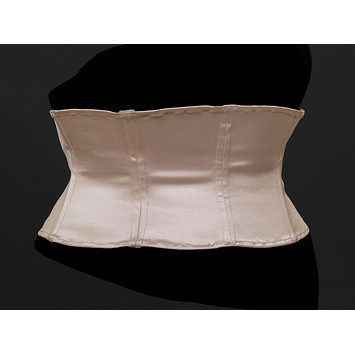
It even came with killer undergarments, a miniature corset:

It was called a 'waspie' by many people, in reference to the wasp-waist of Dior's fashions.

He called it 'corolle' or corolla, the circle of flower petals in a flower. But fashion commentary began calling it 'The New Look', and the name stuck.

The New Look was 'invented', so to speak, in 1946, but thanks to clothes rationing still in effect in many places, it didn't catch on until the 1950s. For several years, then, women couldn't decide if they liked it, or hated it because it covered up their legs, required corsets, and used an unholy amount of fabric. (Add in, on a personal note, I'll bet it was damn hot in summer.) But, really, it looked so good, as usual, women got suckered in.


By 1949 Dior fashions accounted for 5% of France's entire export revenue. For the entire freaking country. They began licensing the Dior name for parfum (ha, read too many French articles today), jewelery, lingerie, men's ties, well, you name it. The New Look appeared in Vogue - the real Vogue - in November 1954.

That clinched it. They were pretty much unstoppable.

Dior continued, grinding out variations on the theme, until he passed away in 1957. As well as a huge loss to his family, it threw a major wrench in the works at House of Dior. After a bit of a scramble, a new designer was located, and Yves Saint-Laurent was hired. (Yes, THAT Yves Saint-Laurent; give me a while, he'll get his own blog post eventually.) Unfortunately for St.L, about the same time he was hired, hippies in the US were burning their bras and wouldn't be caught dead in an actual CORSET, so between general chaos and changing markets, it was anybody's ball game for about six years. It shows in the clothes.


They went from a very well-defined design structure to, well, who-knows what. Although one awesome thing came from that design house, in that era: The trapeze dress or trapeze cut.

If you wear summer dresses, I bet you've got at least one, cut like this, in your closet. Both comfortable and flattering, it's quite a brilliant idea.

After 1965, House of Dior let St. Laurent go. They brought in Marc Bohan, who is given credit for 'rescuing' the fashion house and keeping it solvent. He went back to giving the nod to the New Look, while trying to update it, with varying amounts of success. There's only so much you can do with the New Look before it looks like Something Else. Still, there were hits.


And misses.


In their defense, Dior has always been known (well, almost always been known) for beautifully tailored clothes. So it was rough going in the seventies and eighties when everyone was ditching tailored anything and slouching around in loose, baggy clothes, and loafers with no socks. We rolled up the sleeves of our blazers, for crying out loud! What was Dior supposed to do?!? Okay, produce blazers with rolled sleeves, but adaptation is a bitch for any company.

I think during the eighties they survived on licensing, judging from the looks of the fashion books and sites I've looked at. Particularly sunglasses. Oh, and shoes. Unholy amounts of shoes.

In 1989 Bohan departed House of Dior (in a swirling cloud of parfum, no doubt) and Gianfranco Ferré replaced him, with another minor scrambling of the design concepts.


It's interesting, how every one of these designers managed to - for the most part - keep the wasp waist, mid-calf length, hourglass figure, even the monochrome color, yet totally mix it up.

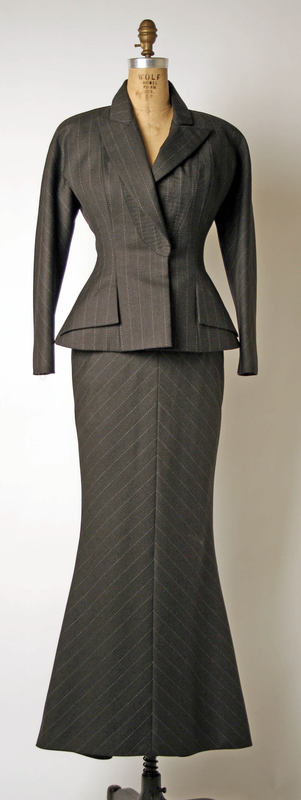
John Galliano was the last change in designers in 1997, and heads House of Dior today. He kicked things off by going back to the original New Look (which was originally Victorian, har). His first collection with Dior got off to a real bang, with a sort of space-age New Look thing going on.


Totally. Badass. If I ever wore suits, I'd wear the hell out of one of those. In orange, please.

He followed it up with a ball gown.

New Look turned up to eleven.

So the New New Look is actually the Old New Look, and... oh, who cares. It's awesome.


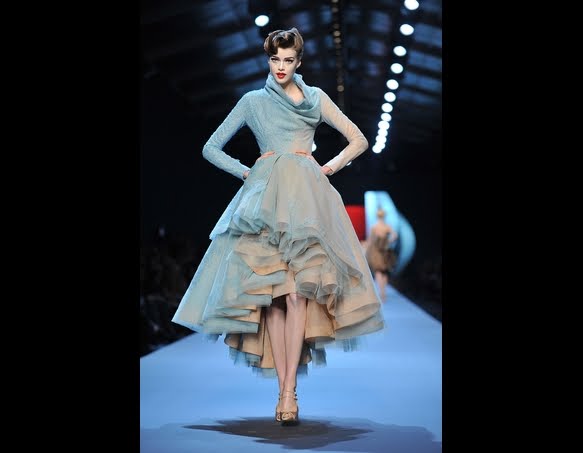
And what inspired today's blog post? The Spring-Summer 2011 collection, of course.


Look familiar? Monsieur Dior would approve, I'm sure.

The dark side to Dior and his New Look is, of course, the impossible body image it conveys. It's been credited (by some) as almost singlehandedly causing the epidemic of anorexia. Although I think that's a little harsh, I do think that the New Look represents a huge step backward in terms of sensible and healthy clothing. Even now we're going through another round of girdles and corsets, as we rage about health and lifestyle. Dior didn't cause it, he certainly didn't invent it, but I wonder how we'd dress now, if no one had the grand idea, back in 1946, to put women back in 'waspies'.

Also?

I want to resurrect Christian Dior and hear what he's got to say to John Galliano about THIS:


ETA: As of March 1, 2011, John Galliano is no longer the head designer at House of Dior. We'll have to wait and see how the next person re-interprets the New Look.